New on Unearthing Optimism: Growing resilient communities starts with trees. LISTEN NOW

Podcast: Exploring Nature, Legacy, and Optimism
Anna Rathmann of the Jane Goodall Institute shares her journey from Yellowstone park ranger to champion for hope, youth, and global conservation.
February 16, 2026
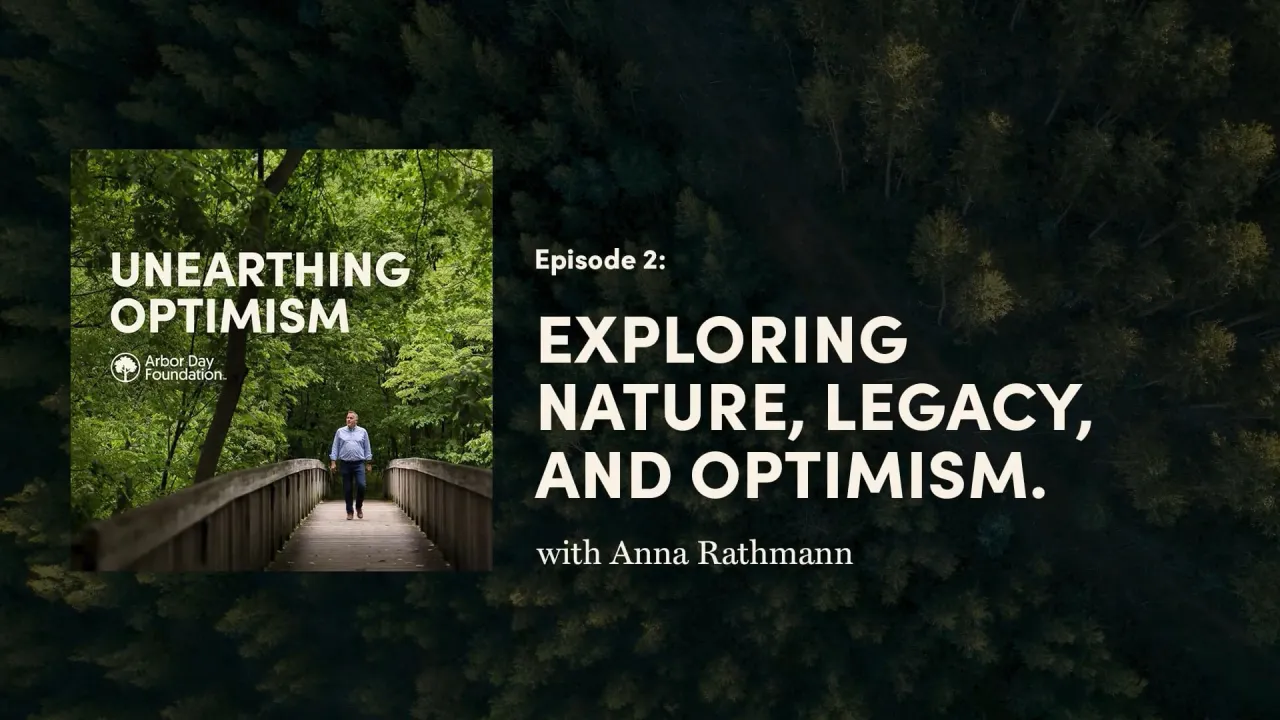
Listen to this episode of Unearthing Optimism on Spotify, Apple Music, and Amazon Music or any other podcast platform.
In this episode of Unearthing Optimism, host Dan Lambe talks with Anna Rathmann, Executive Director of the Jane Goodall Institute USA, to discover her remarkable journey from formative days in America's national parks to the frontlines of conservation. Anna shares stories of wildlife encounters, her most meaningful lessons working with Dr. Jane Goodall, and the power of connecting people and nature for a better world. Explore the indomitable human spirit, youth-led transformation, and why hope is an active choice. Whether you’re a nature lover or just need a dose of optimism, don’t miss Anna’s inspiring perspective on community, legacy, and making a difference. Tune in now and plant seeds of change today.
Please note this conversation was recorded prior to the death of Dr. Jane Goodall. We dedicate this episode to her remarkable legacy.
Full transcript below
Dan Lambe [00:00:00]:
Hi, I'm Dan Lambe. On today's episode of Unearthing Optimism, we're joined by someone whose life and work embody the connection between people and the natural world. Anna Rathman, executive director of the Jane Goodall Institute, usa. From her early days as a park ranger in Yellowstone national park to her leadership role carrying forward the legacy of Dr. Jane Goodall, Anna has spent her career building bridges between conservation, community, and hope. In our conversation, she shares the formative outdoor experiences that shaped her path, the interconnectedness of nature and humanity, and what it means to carry forward Dr. Goodall's vision of hope for the planet. Anna, welcome to Unearthing Optimism.
Dan Lambe [00:00:47]:
It's great to have you. Thanks for joining me today.
Anna Rathmann [00:00:49]:
Oh, thank you, Dan. It's such a pleasure to be here and having this conversation.
Dan Lambe [00:00:55]:
Well, we've got a lot to cover. I've got a lot of things I want to visit with you about. I want to touch base on your work, your amazing work at the Jane Goodall Institute. I want to hear some of your reflections on hope and optimism in the conservation space. I know you're doing a lot of important work, but I do want to start by just getting to know you a little bit better and hear some of your. What shaped you as a person. Okay. And in our research to meet with you, Anna, one of the things I learned was that one of your early jobs was an actual park ranger at Yellowstone national park, the oldest national park, the first national park, probably the most famous national park.
Dan Lambe [00:01:38]:
And I was just. It was so fun for me to hear that, and I would love for you to just reflect on that experience and how it helped shape you.
Anna Rathmann [00:01:49]:
Oh, my gosh. Well, first of all, you're right. Yellowstone national park are one of the most significant parks in our national park system, which is an extraordinary national park system. It's one of these things that when you look at American history, it's something that I think we really got right. To save and protect these extraordinary landscapes, to welcome the public to come and enjoy them and learn about them. And so to be able to be a part of Yellowstone early in my career was such an honor, such a pleasure. It absolutely did shape me. I still have my hat and proudly have it displayed at home.
Anna Rathmann [00:02:35]:
So it was a wonderful experience. And it left me. When you don that uniform, when you're getting up in the morning and you're shining your shoes, because, yes, we did have to shine our shoes. And I was. One of the main jobs that I had was I was one of the first faces that the public would see when they would enter the park. So I work at the entrance station. That was one of my roles, in addition to several others. And to welcome someone in that uniform, you really were taking on this representation of something much larger than yourself, and you were welcoming people into these environments, welcoming them into an experience that hopefully would be positive and unforgettable.
Anna Rathmann [00:03:20]:
And that was a big responsibility and one that was such a pleasure to have.
Dan Lambe [00:03:26]:
So, yeah, that sounds like a really cool experience. And the other thing I'm curious about is what people watching was like at the park. There's lots to see in the park, but I'm curious what it was like to just see how people behaved in the park. And I have to imagine that's a little bit like being a docent at the Louvre in Paris, where most people just come rushing in and go straight to the Mona Lisa. I'm just curious, did people just take off straight to Old Faithful Geyser or what? What did you experience? How did you see it? How did you see people experience the park?
Anna Rathmann [00:04:02]:
Yeah. Yeah. I love that. You know, for a lot of people, it came down to the amount of time they had. And there's different kinds of travelers, right? Like, there's the travelers. Like, I love your analogy about the Louvre. They're the travelers who are coming in, and they've got their checkbox, and they want to hit those sites and check it off. And then there are those who are really just kind of going with it and being present and allowing the animal jams are all part of that experience.
Anna Rathmann [00:04:28]:
They're not on a clock. They know that when there's a traffic jam, there's probably elk or bison ahead. And that's all part of the experience. I will share. There was a story, and I had. This was one of the stranger things that we had encountered, which was you couldn't bring certain types of animal feed through the park. And the reason for that is you don't want to bring in invasive species. So a lot of animal feed will have different types of grass and seeds in it.
Anna Rathmann [00:04:59]:
And this one gentleman, he was a cowboy. He had his prized bull. I think he had just won it at the rodeo. It was, you know, a big deal. This big, beautiful bull, and he's got it in a trailer coming up. And. And I was part of the team who had to go out there and say, I'm. I'm sorry, you can't bring that trailer in with the bowl because of the type of feed that was in it.
Anna Rathmann [00:05:20]:
And, you know, they didn't like that idea, but it was like. Then he turned to me and he said, well, can we just park it over here for a few hours while we go tour the park? And I said, sure, we'll keep an eye on your bowl. So for the rest of the day, we had this beautiful bull that was joining us at the ranger station where I was stationed while he and his family went off to see the park.
Dan Lambe [00:05:46]:
You're a vol babysitter. I'm sure some people were like, well, this is an interesting attraction at the park. Yeah, that's funny. Well, I grew up in Lincoln, Nebraska, and I had three siblings and a parent who were passionate about loading us up into the station wagon.
Anna Rathmann [00:06:04]:
Love it.
Dan Lambe [00:06:05]:
Hitching up our pop up camper and just taking off. And we would go to national parks. We were fortunate. We got to go to state parks, national parks. And my parents were so intentional about making sure that we were appreciating the beauty of nature, the wonders of nature. Even though we probably complained about it quite a bit driving in the back of that station wagon, it really had an impact on me, no question about it. And I'm curious if you had that kind of experience or moment or upbringing or what is it that drew you to this work?
Anna Rathmann [00:06:40]:
Yeah, I think we grew up in the same family, Dan. Same experience. I feel very fortunate that I also had a family. And it was really driven by my mother who. Road trips. That was the greatest word in the English language, you know. And so I grew up in Northern California, which meant that I had access to some more extraordinary national parks. Yosemite, Redwoods, others.
Anna Rathmann [00:07:07]:
And so we would pack up in the car and hit the road, that open road, that beautiful open road, and go see the national parks. And those are formative memories. Those are some of my fondest memories. Growing up with the family and the adventures that we would. Would have and just understanding the landscapes. And one of the things that I feel like I have now carried forward into my own family is we also love road trips as a family with my own children and exploring not just national parks, but national forests, national grasslands, another part of the landscape being preserved. So we live in an amazing country. We live in an amazing world.
Anna Rathmann [00:07:52]:
And getting out there and touching it and experiencing it is so, so important.
Dan Lambe [00:07:56]:
Yeah. And I. I'm so appreciative that my folks did that and we didn't do it. We weren't lavish about it. We'd pack up sandwiches and all that kind of stuff. But the number of times we got to have picnics in Spaces that I. I never. And of course, we didn't have the cameras that we have today, so it is just memories, but it's.
Dan Lambe [00:08:14]:
It really is cool. And in hindsight, I'm just so appreciative that they did that and were so intentional about it. And my mom was the driver of it, too, for sure. My dad did the literal driving. My mom was the. The catalyst to make sure it happened.
Anna Rathmann [00:08:27]:
This is where we're going with the atlas, the road atlas and the. Yeah. Love it.
Dan Lambe [00:08:31]:
Yeah, that's cool. Well, you've built a really cool career, and now you're at the Jane Goodall Institute, and it's an impressive place. The Institute is really well known for protecting chimpanzees, but I know that more broadly, it's about inspiring people to conserve the natural world. And the scale and scope of the work at the Institute is really impressive. But I'd love to have you. Just. How do you describe the work of the Jane Goodall Institute?
Anna Rathmann [00:09:03]:
Yeah. Well, you're 100% right. Chimpanzees will forever remain our flagship species. And that is, by and large, because of Jane's own seminal work with chimpanzees and some of the discoveries that she had and the association with them. And we love our chimpanzees. We just celebrated this past June, 65 years of uninterrupted research happening in Gombe Stream National Park. That's in western Tanzania. And that's where Jane famously stepped off of the boat and onto the shores and started her research, her behavioral research, with chimpanzees.
Anna Rathmann [00:09:43]:
So they will forever remain a very important part of the Jane Goodall Institute. But using Jane's own experience about. She talks about the chimpanzees as giving her the opportunity to do something she loved. As a curious child herself, she would have been happy, and this is her words, studying any animals. But it was chimpanzees where she got that opportunity. And as she learned more about the lives of the chimpanzees, the environments upon which they depended, she started to see more and more the importance of the role of people in that equation. And Jane describes it as the tapestry of life. That's something that she will refer to when she talks about her time in the forest, in those quiet moments observing the chimpanzees, that she really became very aware of this tapestry of life and the interconnectedness of it all.
Anna Rathmann [00:10:42]:
And that then led her. Her organization has manifested that. That evolution of her. Of her own understanding of the interconnectedness of Things. So our programs now, in addition to focusing on chimpanzees, we focus on large landscape wide conservation initiatives. We have initiatives with forests and trees. Of course, chimpanzees need trees, as do people. And then we have programs that are very connected with the communities that we work with.
Anna Rathmann [00:11:14]:
And those can look like a lot of different things depending on those communities. We run the largest chimpanzee sanctuary on the continent of Africa. We started to expand that to other species now too, like gray parrots. And we actually just got a gorilla to come into our care as well. So the project has really expanded and then finally young people, and that is something that Jane is so committed to. Our Roots and Shoots program operates in over 70 countries that we know of around the world and it seeks to inspire young people to make positive impacts in their own communities for people, other animals and the planet. So we have a very broad mission.
Dan Lambe [00:11:57]:
It is impressive and that the engaging of the youth is probably where some of Jane's. Sorry, Dr. Goodall's biggest hope and optimism comes from, is what I imagine.
Anna Rathmann [00:12:08]:
100%. Yep. She talks about that all the time. And you know, it's. It's hard to find Jane happier than when she is surrounded by these young people. They just, they give her their spirit lifts, hers.
Dan Lambe [00:12:21]:
Well, you've had the opportunity to do some travel as a part of this work. I know I saw some writings from you, from some of the visits in Uganda where you saw youth engagement, leading conservation programs, from reforestation work as you've talked about. Tell me what it's like on the ground when you get to see it in practice, how, how is it, how does it show up and like talk more about that tapestry of life and those connections you see between people and the environment?
Anna Rathmann [00:12:51]:
Well, first of all, it's such an honor. It's an honor to go and witness this and firsthand, I mean that, to me, I feel like it is just such a privilege to have that opportunity. I also, I always walk away energized and inspired by my colleagues in Africa and the work that they're doing and the commitment to the work, which is really, really wonderful. And that's another thing that I have to again point back to, Jane, is that so many of my colleagues have been with the Jane Goodall institute for long, tenures, decades. And that commitment to we're not going to come into a landscape and just be there for a few years or finish out a project, but we're really in there as partners to those communities. So I always walk away so inspired with that. What does it look like? It can look like a lot of different things. In the areas you mentioned, Uganda, we partner with stakeholders at all different levels, whether we're working with local educators and doing roots and shoots activities and educating young people about their own environments and the communities and the wildlife around them.
Anna Rathmann [00:14:07]:
It may look like that. It may look like a tree planting initiative. It may look like in Uganda, again, specifically doing survey work about the number of chimpanzees in those environments. So it can look like a lot of different things, which, again, I think is reflective of Jane's own understanding and her approach to conservation work. But it, whatever it looks like, it's always inspiring.
Dan Lambe [00:14:34]:
Yeah. So you and I, in our work, we get to do really cool things, but a lot of our work ends up in conference rooms, boardrooms, meetings, that sort of thing. But every now and then we get a chance to get out there into nature, into the forests, into the work. And I know that for me, inevitably, when I get that opportunity, it's really inspiring. And it helps remind me why we're doing the work we do at the foundation and otherwise, whether it is being in Northern California, where you grew up, and seeing those redwoods or those amazing sequoias, or the fall colors we get to see in some of these places around the country this time of year or around the world. And when I'm in those forests and I see wildlife just by surprise, it just. It stops me in my tracks and just reminds me and just kind of shocks me and forces me to just pause. Because I'm not really good at pausing very often.
Dan Lambe [00:15:36]:
But I bet you've had some cool experiences like that, either with the Jane Goodall Institute and. Or even working back in Yellowstone. Any. Any fun wildlife or anecdotes where you've just been, like, you just gotta pause and appreciate what you're getting to experience.
Anna Rathmann [00:15:51]:
Totally. Totally. Yeah. I'm laughing because one of my favorite, if not, I'm just gonna call it out. My favorite audiences to, to present to and to share stories with are always children. And I love the Q and A that the kids will have. And I often get asked the question, have I been chased by any animals? And, you know, they like to hear those stories. And the answer is, yes, I have.
Anna Rathmann [00:16:22]:
So, you know, whether it's a rhino in the Okavango Delta, a forest elephant in Gabon, Central Africa, or a grizzly in the western United States, it is. Anytime you come into contact with this wildlife, it's awe inspiring. It can also be incredibly humbling. And a recognition that we as a species don't have the kind of natural defenses that many of these other animals do to the environment. And we're not particularly fast, we don't have armor skills, skin, we have no nails or, or teeth to really speak of. And you know, even if we like to think of it, we're not that great of climbers. So yeah, I've, I've been fortunate to come into close contact, sometimes a little too close contact with some really amazing animals. And I walk away feeling humbled.
Dan Lambe [00:17:18]:
Oh, I would love to hear you give one of those presentations to the kids. I, if they're the best. My, my wife is a teacher and, and so I get to do some engagement with kids as well. But that's fantastic. You know, I bet you're like me as I was preparing for this. Anna, we get to do some really cool things. I mean, how lucky are we, right? We get to go to some of the most amazing, most beautiful places and you're probably like me where sometimes my friends are like, you get paid for this. You get to just do this fun stuff and they don't get to see all the time in the airports and stuff.
Dan Lambe [00:17:50]:
But we're pretty lucky. It's, it's pretty great, isn't it?
Anna Rathmann [00:17:54]:
We really are. I, I have often said that I would do the things that I do for free. I mean there have been a couple a hundred percent where you're pinching yourself and just how did I get here? How fortunate am I?
Dan Lambe [00:18:07]:
It's awesome. And you get to work with Dr. Jane Goodall, a really cool experience. I had the chance to see her just a handful of months ago with you give a presentation and it was so cool. She is an icon just like every. It is the way to describe her and what was really cool about that was just to see, not just to hear her speak about hope and optimism because that's what she talks about, but to see her impact on the room and like having her presence in the room and see how there's just kind of like we're, we're a little bit in awe of her in the room and so it's great. I'd love to dig into how, how and how it has shaped you and impacted you. But as a lifelong nature lover and enthusiast, my first question for you is what would 20 year old Anna Rathman say if she was here right now and learned that you were getting to work with Dr.
Dan Lambe [00:19:02]:
Jane Goodall and the Jane Goodall Institute?
Anna Rathmann [00:19:05]:
Oh my gosh. Oh, what would gee Whiz. Well, first of all, I wouldn't believe it. Right. Because that just sounds so like how in the winning the life lottery at that point. Yeah, I don't know. I guess I would want to understand how, how does that happen? And I'm sure you get this question too. I get asked that question.
Anna Rathmann [00:19:30]:
A lot of people who are interested in a career in conservation or preservation or environmental education are often curious of how you can build a career. And my, my response is always the same, that it, this is a very inclusive community, professional community. It takes all types. You don't have to have a PhD in biology. You don't have to. I mean Jane doesn't even have that. Jane's PhD is in ethology, so the study of animal behavior. You don't have to have some long storied academic credentials.
Anna Rathmann [00:20:12]:
You can be a finance person, you can be a cpa because we need those too at the conservation organizations. You can be a writer and tell beautiful stories. You can be a filmmaker, you can be a photographer. You know, all these different things that there's, there's a space for you here. So what would I tell 20 year old Anna? I would say, what would 20 year.
Dan Lambe [00:20:35]:
Old, 20 year old say? I can't believe it. But yeah. What would you tell 20 year old today, looking back now?
Anna Rathmann [00:20:40]:
Gosh, yeah. To just enjoy every moment. It's an amazing ride.
Dan Lambe [00:20:46]:
That's a great answer. And I'm sure you weren't even thinking about that back then, but you're right. And you just, you do what you do, you work hard and opportunities just come about. But if you're adaptive and open to it and so that's really, that's awesome and it is great and you get to work with an icon. What are some of the things you've learned as you've been working with Dr. Jane Goodall? What are some of the things you've learned that maybe you were surprised about not realizing you were to learn from this experience?
Anna Rathmann [00:21:16]:
Yeah, I learned something from Jane every day. And that is such a privilege to have that opportunity to know her not only as that public figure which is extraordinary with an amazing body of work, but also know her as a person and how she approaches decision making or approaches her work. Jane has an amazing work ethic which is just an honor to see in action. And it's a reminder to all of us of what you just said of working hard and showing up really matters. Jane also is a very values driven person and I think that has been something that I so respect to see in the decision making. I have seen her pass on opportunities that many people would see as very lucrative and good opportunities, and they may not align with her values or what it is that she wants to show through her work and through her platform. And she will pass on them without looking back. And that kind of conviction of character and commitment to values is really, really impressive.
Anna Rathmann [00:22:35]:
And, you know, such a privilege to see both professionally, but also to see her do that personally. But then I also learn, like, other things from her, which is so fun. Jane is a masterclass in media and interviewing, and the way that she can pivot a question and is incredible. So watching her engage with the media, engage in interviews, is just so good. And, in fact, there was one instance where Jane and I were on stage together, and it was very new in my role. I didn't know what I was. You know, I got pulled into something, and Jane, in real time, guided me and corrected me. So it's just, you know, there's.
Anna Rathmann [00:23:26]:
There's things that I learned from a scientific perspective, from a values perspective, and just the fundamentals of being a public person. She's taught me a lot.
Dan Lambe [00:23:37]:
Well, when we were together, and I saw her speak just a handful of months ago, I saw it in action, where, in this moment of divisiveness, people were almost trying to prompt her in with questions about how to pick a side, and she wouldn't do it. She's a uniter and a unifier, not a divider. And you could just see that in practice. And it was impressive and really cool, and it's what we need right now. So that was awesome. So let me ask you this, because, of course, I work for the Arbor Day Foundation. Arbor Day is a national holiday. It's been around since 1872.
Dan Lambe [00:24:12]:
It's a global holiday now. And sometimes I look and I'm like, I feel this real responsibility to not mess things up. We've got a credibility and a trust and a culture around Arbor Day, and it's a unifying message as well. And I'm curious the sense of responsibility that you feel in this role, not just for the legacy of Dr. Jane Goodall, but the growing, important legacy of the Jane Goodall Institute. Curious how much you feel that responsibility also.
Anna Rathmann [00:24:49]:
Yeah, that's a big part of the role. Do I feel the responsibility? Of course. But what I know and what I know to be true is I'm not alone in this. And I look to my colleagues, many of whom have worked with Jane, collaborated with Jane for many decades, and I know that we are all carrying this forward. So it's not something that it's any one person's responsibility. It is truly a shared responsibility of those of us who have had the privilege to work with Jane, be inspired by Jane and continue her work together.
Dan Lambe [00:25:27]:
Well, you're doing a great job. And I'm a big fan of Dr. Jane Goodalls, of course. And she's become known not just for her work, but for her perspective in many ways. And she's this constant pillar of hope. And she's talked often about these four pillars, why she has such hope. And she shared this message with us as a part of this podcast on one of those that she calls the indomitable human spirit. And we just want to give a quick listen to that.
Speaker C [00:25:59]:
Right now, there are people in the world who are tackling problems that are impossible to solve. There are icons like Nelson Mandela, like Martin Luther King, many, many of those icons. And we're surrounded by people who've overcome terrible problems in their lives, but also every single one of you as an indomitable spirit. So many people don't realize that. They're afraid. They don't let that spirit grow. They don't think, I'm here to make the world a better place every day. They think they don't matter, but they can make the world a better place.
Speaker C [00:26:42]:
This indomitable spirit does raise us up and helps us to live up to who we can and should be.
Dan Lambe [00:26:51]:
I love that. I love that, that calling to everybody to recognize that they can have a belief and a courage to do great things. And I, I'd be curious, just hear your reaction to that, Anna.
Anna Rathmann [00:27:06]:
Yeah, I love that. You know, when I hear, when I hear Jane say that, when I think about who is she talking to? She is talking to all of us. That message is whatever station in life you find yourself, that message is, it resonates and it's relevant. And I think that's where Jane, when she talks about, we all have a responsibility, we all have a role to play, we all make a difference. It's absolutely true. All of our decisions, every single day that we live has a ripple effect associated with it. And for Jane, that optimism, the hope, the well earned hope, it's not a flight of fancy kind of, well, well, we hope these things will happen. It's a choice, it's a deliberate decision to have hope and to have optimism, the kind of hope and optimism she talks about and that's characterizing this indomitable human spirit, this spirit of when we get knocked down, we get back up.
Anna Rathmann [00:28:13]:
When we have a problem in front of us, we solve it. We innovate, we evolve, we work together, we find others who will help us with whatever challenge we have in front of us. And that's such an important message to everyone.
Dan Lambe [00:28:29]:
Yeah, I agree. And it is inspiring. And we think about how do we give people the opportunity or the pathway to engage. They can write a check, they can donate, and that's great and important. But how do you at the institute try to create pathways, tools, resources, initiatives that actually give people a way to say, okay, I think I can be a part of this, Whether it's a youth program or otherwise. What are some of the examples of how you help hold people's hand into actually taking action?
Anna Rathmann [00:29:10]:
So there's a lot of different ways. And roots and shoots. You mentioned a youth program. Roots and shoots, that I shared about earlier is a great pathway. It encourages people to find one another, too, who are doing good work and committed to similar things. It's a grassroots initiative. So it is something that is very directed by the individuals who engage in it. So that's a wonderful pathway to find others who are similarly interested and committed to things.
Anna Rathmann [00:29:46]:
But there's so many other ways. And that's what Jane talks about, too, is all of us are making that difference. So whether you're choosing to have, you know, I'll think now about, like, cut flowers and a floral display. Jane always is advocating for a plant that can be planted afterwards because, you know, what a beautiful thing that after an event, we can all go plant a tree, a flowering shrub, you know, something along those lines. So it's just. It's being very mindful about the ways in which we make decisions, we engage in our world, and recognizing the ripple effects that each of those decisions has.
Dan Lambe [00:30:25]:
So, Anna, how do you do it in your own life? I know you shared some of the work you're doing through the institute. How do you keep your own personal hope and optimism alive? Do you turn to nature? Do you turn to music? Do you turn to friends? What are. What are some of the. What are some of the ways that you keep your optimism? Because you. When you walk into a room, you light it up. You really do. You're a positive force in the community, and we're grateful for it. So how do you keep that positivity out there?
Anna Rathmann [00:30:55]:
Yeah. Thanks. Well, I think for me, it truly does come back to finding these. These individuals who are doing things, who have new ways of looking at things. I naturally will gravitate to people who have that kind of optimism or who have a creative solution for something that's exciting, that is so exciting. So I reflect on a lot of them. And I also. Jane and I talk a lot about how nature can restore itself, too.
Anna Rathmann [00:31:33]:
That's something that we've had the privilege, and I know you have, too, through our work of seeing landscapes that were once degraded and really just overused and through various consumptive uses, really had fallen apart ecologically. And to see that with small interventions, life comes back and it can thrive. And so when you see that kind of turning of the tide and that things can come back, hope is not lost. You know, that just feeds more hope and encourages others to join you in that. And I think it's. Storytelling is really important, too. We talk a lot about this because Jane is such herself a masterful storyteller of the importance of both the heart and the head. You need to have good science.
Anna Rathmann [00:32:30]:
You absolutely need to have good data, well researched hypotheses, all these sorts of things. But then you ultimately need to make it relevant to an audience. And that audience can be very different, depending on who it is that you're talking to. And you need to touch people's hearts, because it's that emotion that causes people to take action. So, you know, through storytelling, a lot of that can come out.
Dan Lambe [00:32:57]:
Yeah, that's great. Well, I will tell you, this is a podcast about hope. It's about optimism. It's called Unearthing Optimism. And so thanks for being a part of it. And of course, it's coming from me as CEO of the Arbor Day Foundation. So we do talk about trees, and we've been able to partner together on some tree planting, which has been cool. But I have to ask if you have.
Dan Lambe [00:33:20]:
Is there a story? Is there a memory? Is there a favorite tree in your life? Is there any kind of anecdote around trees that has been important to you that you can share with us?
Anna Rathmann [00:33:31]:
I have two. Can I share two?
Dan Lambe [00:33:33]:
Of course you can share two.
Anna Rathmann [00:33:36]:
I won't share a forest worth of stories. I'll just share two. The first one is, yes, through our partnership work, I'm very happy to say I have a tree that is named for me in Uganda that was planted and it was geotagged, and so I can go back and I can visit that tree. And every time I'm there, I try to get there. And it's so fun because when it was planted, it was just a little guy the last time I was there, taller than me. So, you know, that, to me, is so Special. And I'm so grateful to the many partners, both international partners, but also our partners in Uganda are forest monitors who ensure that that tree and all the others are thriving. So that's a favorite story.
Anna Rathmann [00:34:21]:
And then domestically, in the US There is a very special tree close to where I live that is one of these old trees. We did the thing where you take a string and you go around the trunk of the tree and then you measure it, and you can get a general estimation. And we estimated that the Tree is over 250 years old. So it's a very old tree. And you think about what that tree has seen and the changes that that tree has seen over that time and the people who have enjoyed that tree over that time, and us included, that there was a moment during COVID when the world was shutting down and children were home from school and everyone was home, that that tree became this quiet, beautiful gathering place where some of the local kids would come together and they would read under that tree. And it was a way for them to be outside and to join each other in fellowship under this beautiful tree and the kind of peace that it gave them to talk about whatever it was that they were experiencing. And it was just. It's a very special tree.
Anna Rathmann [00:35:39]:
I'd like, you know, at some point, that tree could tell us some stories.
Dan Lambe [00:35:43]:
You know, there's a saying we. Thanks for sharing those. We have a saying that we believe trees bring people together to do great things, and that's a great example of trees being a unifying force, even if it's just for the shade and solace during a tough time to read. But that's a great story, and I appreciate you being with us today, Ann. I really do. Thanks for sharing your stories and your history with us. You talked about being a part of something that's larger than yourself, and I love your humility. That's one of the traits that we value in people, is like, we know we're just a part of something much bigger.
Dan Lambe [00:36:21]:
But what you're doing in your leadership, what you're doing at the Jane Goodall Institute, is making an enormous difference in the world. And it's a part of what gives us hope and optimism at the Arbor Day foundation, that we've got leaders like you out there doing that work. So thanks for being our friends, thanks for being our partners, and thanks for joining us today. We really have appreciated it.
Anna Rathmann [00:36:40]:
Oh, thank you again. This is such an honor. And I'll just close by saying something that we always say with Roots and Shoot, which is together we can. Together we will. And together, we must change the world. So thank you to Arbor Day for being a part of that.
Dan Lambe [00:36:54]:
Thank you, Anna. Take care.
Anna Rathmann [00:36:56]:
Thank you.
Dan Lambe [00:36:58]:
That's all for this episode. And Anna's words remind us that conservation is not just about protecting wildlife and restoring forests. It's about nurturing hope, fostering connection, and recognizing our shared responsibility to this planet we call home to our audience. Thank you for tuning in to Unearthing Optimism. And if today's episode moved you or inspired you, we hope you'll subscribe, leave a review, and share the show with a friend. Until next time, keep planting those seeds of hope.