New on Unearthing Optimism: Growing resilient communities starts with trees. LISTEN NOW

Podcast: Planting Optimism in a Changing World with Dr. Cassie Rauser
TreePeople CEO Cassie Rauser reveals how growing resilient communities starts with trees, hope, and deep roots in local engagement.
October 19, 2026
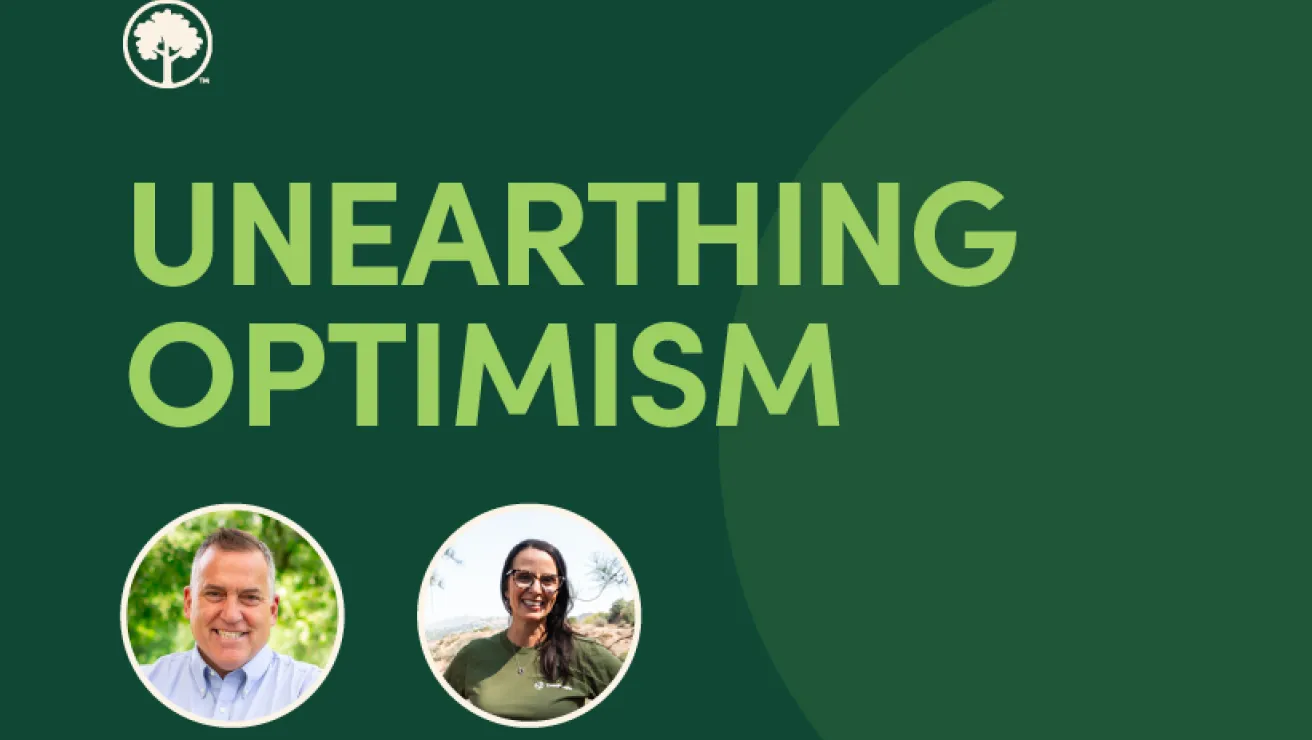
Listen to this episode of Unearthing Optimism on Spotify, Apple Music, and Amazon Music or any other podcast platform.
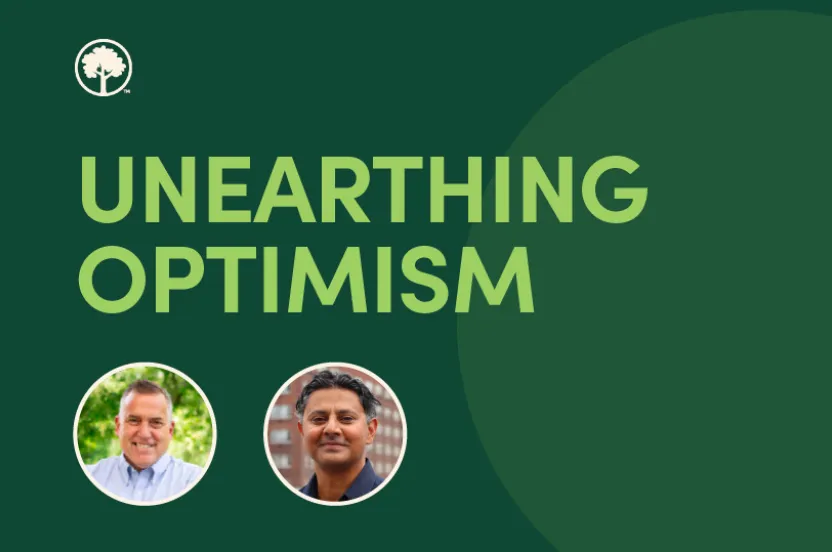
In this episode of Unearthing Optimism, Dan Lambe welcomes Dr. Cassie Rauser, CEO of TreePeople, to explore what it really takes to foster environmental resilience across the diverse landscapes of Los Angeles. Discover TreePeople’s holistic approach to climate action, from large-scale tree planting to community education programs, wildfire recovery, and creating schoolyard habitats that inspire the next generation.
Whether you’re a tree lover, an advocate for community action, or curious about the role of urban nature in our future, this episode will leave you inspired by what’s possible when people and trees thrive together.
Tune in now and be part of the hope in action.
Dan Lambe [00:00:05]:
Real stories, real change rooted in the power of nature. You're listening to Unearthing Optimism from the Arbor Day Foundation. Hi, I'm Dan Lambe, and today we're joined by Dr. Cassie Rauser, the CEO of TreePeople. TreePeople is a tree planting nonprofit working at the intersection of science, policy, and community in Southern California. From seedling production to community forestry, their work helps neighborhoods recover, adapt, and thrive in a changing world. In this episode, I'll talk to Cassie about growing resilient landscapes and restoring the connection between people and nature. Cassie, great to see you.
Dan Lambe [00:00:56]:
Welcome to Unearthing Optimism.
Dr. Cassie Rauser [00:00:58]:
All right. Great to see you, Dan.
Dan Lambe [00:01:00]:
Yeah. Thanks for joining me today. I've got a ton of things I want to cover with you, but I want to start with TreePeople a little bit first. I've gotten to work with a number of your just fantastic committed team members. They are amazing. And I know you do work in community forestry, forest restoration, school greening, policy, a whole host of different things. And you're celebrating your first year as CEO of TreePeople, right? So congratulations.
Dr. Cassie Rauser [00:01:27]:
Thank you.
Dan Lambe [00:01:28]:
And I would love for you, for our listeners to just have you explain a little bit more about the organization and what drew you to TreePeople.
Dr. Cassie Rauser [00:01:35]:
So TreePeople is a longstanding environmental organization in Los Angeles. We have celebrated 53 years, and I've been there for just about a year. And, you know, it's an organization that, of course, we plant trees. We work in the spaces of community forestry. in the wildlands, environmental education, community outreach. We host thousands of volunteers every year. So it's a really comprehensive approach to planting trees and thinking about trees as an essential piece of our both urban and wildland infrastructure.
Dan Lambe [00:02:12]:
I've known about TreePeople for a long time, and it is a model organization for other nonprofits. and really cities all across the country and around the world. Any surprises or aha moments in your first year as CEO?
Dr. Cassie Rauser [00:02:28]:
I've lived and worked in LA in this space for a really long time, about a dozen years. You know, I thought I knew TreePeople. I think I didn't really grasp the impact and that scope of work that we're doing. I was certainly attracted by the fact that the organization is just incredibly well-respected and has you know, really great impact. But, uh, and I'm a biologist, uh, ecologist and evolutionary biologist by training. So it's just really full circle for me.
Dan Lambe [00:02:57]:
I want to get into that. I feel exactly what you're talking about at the Arbor Day Foundation. Inevitably, people will work with one piece of our programmatic work, and they don't know that there might be 20 to 30 other areas of programmatic engagement we have. And I can absolutely see that with tree people, Last time I got to work with TreePeople was planting some trees out in Ontario, California. It was just fantastic. Your team, they know exactly what they're doing and they're so well respected in the community. You mentioned you are a trained biologist, this lifelong love of nature. Tell us, was there a moment early in your life that pointed you towards this kind of work? How did, how did that happen?
Dr. Cassie Rauser [00:03:37]:
Not really, other than the fact that I grew up immersed in nature necessarily. So I'm from a very rural part of North Dakota. And so I grew up playing, you know, in the fields, in the trees, on the riverbank, you know, jumping. So I always had that deep connection with nature just by the nature of how I grew up. Now, when I grew up though, I was in a town of about 40 people. And what I understood as potential professions certainly didn't— did not include something like this. I had no idea you could do something like this. So I knew I wanted to go to college.
Dr. Cassie Rauser [00:04:11]:
I thought the only professions outside of farming or supporting that was being a doctor or lawyer. So I went to be a lawyer and I wanted to be a social justice lawyer. And I quickly learned in doing that work, actually, in an organization, in the PIRGs, actually, the Public Interest Research Groups, they were focused on both social justice, but also environmental justice. And I thought, oh wow, this environmental stuff is so cool. So I started taking some courses in environmental science and then I learned, oh, you can do research and you can study butterflies and you can, like, all this cool stuff that I just, I had no idea growing up that those types of things were options. So I quickly changed my pathway to environmental science. I loved all parts of it. I loved the environmental justice component.
Dr. Cassie Rauser [00:05:02]:
I loved the biology component, but I also really liked the policy. So I had a poli sci minor and kind of mixed it all up. What I was really attracted to was impact work though, advocacy and impact work. So college was a great experience for me and exposed me to a lot of, a lot of opportunities that way.
Dan Lambe [00:05:21]:
From a town of 40 people to Los Angeles, California, it's a really great story. I, um, and a great evolution and like a great lesson to others. Just be, have your eyes wide open. To the opportunities that might come and just don't feel like there's a, always has to be a straight path to where you're going. I know you've had a number of different roles before coming to TreePeople, and you've looked at environmental issues, environmental solutions from a lot of different perspectives. And of course, we focus on trees the most at the Arbor Day Foundation. We know that's not the only important thing to be focusing on, but it's what we focus on. And I'm curious to have you share with your experiences that you've had in other areas.
Dan Lambe [00:06:04]:
What is it around trees that you think offer climate solutions that maybe other opportunities don't offer? What is special about trees?
Dr. Cassie Rauser [00:06:13]:
So as you mentioned, I have worked on a lot of other climate-related plans and interventions, et cetera, throughout the Los Angeles region. So I've worked in the space of energy and water and transportation, and of course ecosystems, both working in Developing the first Los Angeles County sustainability plan. I recently worked on, before I started at TreePeople, the mayor's climate implementation plan. So I have a really broad perspective when it comes to climate solutions and interventions. And what's so remarkable about trees is that this is a multi-benefit solution. So it's natural green infrastructure that isn't just serving a single purpose. So some of the other interventions that we're talking about with regard to climate, You know, the way we build and insulate homes to, you know, the way that we manage water and its transition from the urban space to the ocean. Trees can really influence all of those things and really improve public health, improve the way that we manage our water systems all at the same time.
Dr. Cassie Rauser [00:07:21]:
And they're much cheaper. They're much cheaper than the gray infrastructure. What we say at TreePeople is like, this is the only piece of infrastructure that increases in value over time.
Dan Lambe [00:07:30]:
That's great. Well, and there's more and more science, as you say, that helps to paint that picture of why trees are so important. And it is health, it is water quality, it's air quality, all of those things. But it isn't only scientific. We know that there are a lot of cultural influences with trees as well. Trees and green space just inevitably shape how we live and how we connect with each other. How does that show up in your work at TreePeople? How have you observed that in your career?
Dr. Cassie Rauser [00:08:07]:
The first time I did work that really involved trees was actually when I was in Costa Rica. So I worked for a private company, but my job was to set up a nonprofit that worked in a public-private partnership with their national park system. And so I don't know how much you know about the work in Costa Rica, but, you know, Costa Rica is really the place where they protect tons of their land, right? It's like upwards of 25, 30% of their country's land is already protected, but they've really developed the model of ecotourism, right? So how do you protect this land but give people enough access that they appreciate it, know it, and protect it? And what I learned there in working with the local communities, was how absolutely connected everyone there is to the land and is to trees. And so we had, one of our major programs there was a tree planting program. And that was just something that was absolutely embedded in their social and cultural ways of doing things. There is no separation of people and nature in Costa Rica. Every Costa Rican feels completely connected to nature. Now, I would say that that connection in the United States is not the same, and it varies across communities.
Dr. Cassie Rauser [00:09:31]:
And we have all sorts of diversity here, especially in Los Angeles. We have people from all over the world, and their connection to the natural world and their connection to trees really depends on, you know, their experience and often where they're from. Like I said at the beginning, it's really important to be very community-specific when you're thinking about a successful tree planting effort because they're going to come in with those different perspectives and connections to trees and to the natural world. And for a tree to be planted and cared for and grow into, you know, an adult tree with a large canopy to provide the shade that we're looking for, you really need the buy-in of the community and the engagement for that to be successful. So I think it's so important to not just think about You know, the scientific right tree, right space kind of approach to tree planting. I think that the community engagement component is just as or more important than the scientific.
Dan Lambe [00:10:34]:
Cassie, I could not agree more. And I see TreePeople as a great example of earning that buy-in, getting that feedback from the community members before you just parachute in and say, lucky you, we're here to plant trees. But rather to earn that respect so that, to your great point, they want to help care for the trees and advocate for the trees. We have worked throughout California a lot over the years. The Arbor Day Foundation has a lot of wildfire recovery, unfortunately, and that is not a problem that is going away. It's only increasing. We're still seeing a lot of wildfires, the traditional wildfires on television, the news, but in 2025, we saw hit the cities in Los Angeles, the Palisades, Altadena. I've had the opportunity to go visit both of those communities.
Dan Lambe [00:11:22]:
We're going to be actively helping to plant in those communities. There's great leadership there. And I know you lived through it. You were there and living through it. I would love you to share, if you don't mind, what was it like for you, those fires hitting so close to home before we even dig into what recovery looks like?
Dr. Cassie Rauser [00:11:39]:
Thankfully, I didn't live Really, I didn't live in the path of the fire. I'm right in between both of the fires that happened. So they happened on, you know, like the west and the east side of Los Angeles. And like you said, those fires are so different. It's like almost, it's almost not doing it justice to call it a wildfire because it wasn't a wildfire anymore. Fire was, you know, passing through a community and it continued not by burning down trees anymore, but by burning houses, right? So houses were catching on fire. This wasn't a forest catching on fire. You know, there was incredibly extreme conditions.
Dr. Cassie Rauser [00:12:14]:
It's kind of like the perfect awful storm. I mean, there was a blanket of smoke throughout the entire region, so everybody was impacted in some capacity. And I actually remember sitting outside on my porch during one of those days, and the haze, I mean, just the haze. And I had, my yard is completely transitioned to native plants. I had this beautiful hummingbird sage, covered in ashes. Like, it was crazy. Like, everything was covered in ashes. But I took a video of this hummingbird that was feeding on the flowers of the plant.
Dr. Cassie Rauser [00:12:53]:
And I look back on that and it reminds me of like that really dark feeling that laid across the entire region. Recovery with regard to, you know, trees at that time was not the first thing on people's minds. And it wasn't It's just, it's just, it's not the right thing to do at the time. Even now, planting trees is like, okay, there's a lot of other things that maybe need to happen first.
Dan Lambe [00:13:18]:
Well, let's talk about that, Cassie, because the recovery efforts, I know TreePeople is a part of the holistic recovery efforts. We've been a part of some of those conversations, not just in the cities and towns when the time is right, but in the forest lands as well. And it's important. And when we get calls after these kinds of disasters and people are very eager to help and they turn to a place like the Arbor Day Foundation, probably just like tree people and say, we want to plant those trees back. And sometimes you just can't do it right away. Sometimes it is the buildings that have to happen. Sometimes it's land prep. But do you mind walking through a little bit for our listeners, just what some of the other considerations are when it comes to timing for planting trees after fires, particularly?
Dr. Cassie Rauser [00:14:05]:
Yeah, I mean, it's not safe. The types of material that burned is, you know, there's a lot of toxic substances within that material in our buildings. And so that part is different. You don't want to go in there and be digging in the soil and planting trees until we've thought about soil, soil remediation, and all of that. So we want to be safe. The other thing, of course, is just thinking about all of the infrastructure that needs to be rebuilt. Because of that gray infrastructure though, I know that at least in the Palisades, which is City of Los Angeles, Altadena is not City of Los Angeles, there's sort of a moratorium on planting in parkways. So we've planted a little bit, not in the parkway spaces because we need to, you know, align with what's happening with, with the gray infrastructure, but some parks have begun some planting efforts and private, of course.
Dr. Cassie Rauser [00:14:59]:
you know, can, can do as they will, but it's still a long road ahead. I mean, we're almost 2 years. People are just starting to rebuild. There's still a long way to go.
Dan Lambe [00:15:09]:
It's hard. Although we still unfortunately do have lots of wildfires happening, not just in California, but all around the country and all around the world. And I know you are a part of those recovery efforts, an important part of restoration efforts. We hear this, and I'm going to invite you to help answer this question. After these wildfires, sometimes we hear people talking about, Why would we replant? We're just replanting more fuel for these fires. They'll just burn again. And why would we rebother? Why would we bother replanting these trees at all? I have my own answer for it, but I'd love to hear your answer for those kinds of statements.
Dr. Cassie Rauser [00:15:46]:
Because of the complexity and understanding or confusion about wildfire and how that spreads, and then an urban fire and how that spreads. There's a lot of fear, I think, around trees and things that can burn. But I think what we know is that, you know, trees planted in the right way and maintained in the right way are in fact not ways that spread fire, right? And can be actually beneficial in even stopping embers from moving from one building to another. It's far more complex than just trees are not the reason that the city burned. Right. It's just simply not. In the wildland, it's very different. Should we have barren wildlands and not have trees? No, I don't think many people would say that, but when we do wildland recovery, it's very, very different.
Dr. Cassie Rauser [00:16:39]:
So we do a period where you stop and wait. So if there are non-native species that start to pop up and take advantage of the cleared space, We make sure we remove them because the thing is, is that the non-native species are much more likely to burn. So we remove those, we make sure that the native species are there. The native species are adapted to these types of dry conditions, and they in fact are less likely to burn.
Dan Lambe [00:17:07]:
Right. Well, and Cassie, what you're talking about is forest management in so many ways, just proper forest management, whether it's in a community or whether it's in the forest lands. Managing for the right trees, planting, and then caring for those forests. And we have to do it because the benefits, the co-benefits that you talked about earlier, the multiple benefits that these forest lands and trees bring, it's just, it's an essential. And I know you've been a part of resiliency conversations in Los Angeles. You said for about 12 years already, and Los Angeles and California are very unique climates. What do you think other communities could learn from Los Angeles when it comes to climate resilience? Not just trees. But trees and other, other resilient strategies.
Dr. Cassie Rauser [00:17:50]:
You know, we say in LA, like, you can literally surf in the morning and ski in the afternoon. And, and so the diversity in our, in our topography, our geography, our microclimates is huge within, you know, a 2-hour drive. And so we do have desert-like conditions, but we also have, you know, a Mediterranean climate. We have mountains, we have the shoreline, we kind of have it all. We use different approaches in those different spaces, and you should. So I think what folks can learn from Los Angeles is thinking about a climate response in a really holistic way, where we've prioritized biodiversity, native biodiversity, and looked at the way we can use green infrastructure combined with gray infrastructure to be more resilient. We have really been leading in the way that we can integrate that throughout the region. So school greening maybe is, is one example.
Dr. Cassie Rauser [00:18:49]:
CAL FIRE is a big funder of school greening projects in the Los Angeles region.
Dan Lambe [00:18:53]:
The State Forestry Agency, for our listeners, CAL FIRE is the California State Forestry Agency, basically.
Dr. Cassie Rauser [00:19:00]:
Right. So what this does, we just had a school greening ribbon cutting last week, and oh my gosh, the outcome was remarkable. Right. So we removed 15,000 square feet of asphalt on this school campus in the most polluted census tract in California. So this school is in the most polluted space. It's near the port, it's near oil refineries. So we removed this asphalt, we replaced it with 1,000 plants and 50 trees, and we integrated a stormwater capture, natural capture system that can capture up to 22,000 gallons of water.
Dan Lambe [00:19:40]:
Wow.
Dr. Cassie Rauser [00:19:41]:
I mean, it was just remarkable. And not only did it result in a huge decrease in the heat in that school, so we had students out there with their little thermometers, and on the asphalt, it was reading like 120 degrees. And then in the space that we had redesigned, it was reading 40 degrees cooler. So like what a, like an incredible resilient approach. So we capture water, we're managing stormwater. We're providing a cool space for students to learn and to play. We are also providing native habitat. All of the plants that we planted there were native, and so we're providing new habitat, new ecosystem space.
Dr. Cassie Rauser [00:20:25]:
It will attract insects, it will attract the butterflies, it will attract the birds, and the students have the opportunity to engage in that. But maybe one of the most important things that something like this does is show people what's possible.
Dan Lambe [00:20:38]:
I was going to say the kids and the parents must have just been blown away.
Dr. Cassie Rauser [00:20:43]:
They love it. And they were a part of it from the beginning.
Dan Lambe [00:20:46]:
You know, Cassie, those kind of school greening programs, it's such a great example of resilience and planning. And it isn't just about beautification. It is, it makes the school grounds much more beautiful and inspiring, but it is, it is about It is about water management. It is about air quality. It is about mental health and, and for these, these students and these teachers. And so tell me more about how has working in community forestry in this space changed your sense of hope for the future?
Dr. Cassie Rauser [00:21:23]:
Going to that ribbon cutting and, and spending time with the students and their families is, it's everything, right? You know, You see hope all over the place in that moment. But every planting that I have been a part of where you're going out to a community, the neighbors are out there planting the trees with you, we name the trees together. So every tree that gets planted gets named. We sort of bless the tree. Trees need, what is it? Trees need people, people need trees. That is a moment that is so special for people. They do have hope. They have ownership of the natural space around them, and now they have a personal connection to it.
Dr. Cassie Rauser [00:22:06]:
And so of all ages, people of all ages, often in many communities, because we do talk, we're engaging with them prior to the planting, they get to pick their trees. Like, here's your menu, here's what's possible, what resonates with you. Working with community, working with students, but working with community generally always Brings me hope.
Dan Lambe [00:22:29]:
And seeing their enthusiasm for the fact that they can make a difference. They may not be making a difference on the entire planet, but they can make a difference in their community, their part of the world. Yeah. Well, speaking of that, it takes planning, it takes big initiatives, and you are a part of a big initiative rooting for LA as you're planning for the 2028 Olympics. I think you have a goal of planting 28,000 trees before the Olympics, and I, I, what's the significance of that? Uh, tell us about how that's an important part of the green infrastructure of Los Angeles and what it means to tree people.
Dr. Cassie Rauser [00:23:06]:
Like fire recovery, the Olympic planning is really focused on gray infrastructure. Like, what can we do about transportation? You know, what can we do about the stadiums and the spaces that we have to hold these, these events? So the events are happening all throughout the region, and I think everywhere that they're happening, we already work. So TreePeople is already working in Riverside County, right? TreePeople is already working all over LA County. So we are working in communities close to the spaces and those communities that will have the greatest impact from the Olympics. And so the way I thought about this is, one, I didn't see anybody making a green infrastructure commitment. I'm here to challenge that. And so my, when I said to my team, let's be, let's see, we gotta be cute about this. Like, let's plant 28,000 trees in the next 2 years.
Dr. Cassie Rauser [00:23:59]:
And they were about, they almost had a heart attack, right?
Dan Lambe [00:24:02]:
That's a lot of trees.
Dr. Cassie Rauser [00:24:04]:
It is a lot of trees. It's a lot of trees. It's, and it's not easy and it's not, it's not cheap, right? I mean, anyone who's in this business knows, um, that's a, a big commitment to make. I think we're really the only green infrastructure commitment, but it has already just really inspired folks and people love it and are supportive of it. They wanna be a part of it.
Dan Lambe [00:24:27]:
Well, it's a great way to grab, uh, an event, a world event, and create a legacy opportunity for Los Angeles. I mean, those trees are gonna have generations of impact. I, I know in 1996, Atlanta had an enormous tree planting goal and initiative around the Olympics coming to Atlanta. It had an amazing impact for years and years. To this day, they still have created almost a culture of tree planting and care in the city. You've been in the environmental space for a long time, working in communities. I'm curious if there's been an evolution in the conversation or the narrative that you're hearing. Are there questions that you're hearing today that you didn't hear maybe 15 years ago when you were in this space? Are there, is there a changing perception? Are there different questions you're hearing today than before?
Dr. Cassie Rauser [00:25:25]:
I mean, a lot has changed and it feels like change isn't fast enough a lot of times, but I feel actually really optimistic because things are really different. I mean, in the environmental world generally, I think there used to be kind of a, A fear-based approach. I'm not a part of that anymore. I mean, I think it's evolved. I think it's more of an optimistic approach of what's possible. Imagine what is possible. The other thing that has changed so much is the feeling and understanding around biodiversity. What is it? Why is it important to the urban space? And that connection or reconnection of people with nature in the urban space, that it's not something separate.
Dr. Cassie Rauser [00:26:04]:
It's not something that's just nice to have. It's actually really essential for our wellbeing and that it has multiple benefits. So I do feel like there's that shift in like, you know, from nice to have to essential. It's slow, but it's happening. And I'm here for it. And here, here, here to push it because I think it's critical. It's critical with everything happening around us. Like the natural world brings, brings people joy, right? It brings wellbeing.
Dan Lambe [00:26:33]:
I would echo what you're saying, Cassie. I hear that in communities all around the country and around the world that trees are not seen as just a nice-to-have anymore. They are a must-have part of any community, any environment, and there's science that backs it up. And I think more and more enthusiasm around it as well. And, and, and it's also largely because of organizations like TreePeople that can enable and engage people to make that happen and educate people as well. So thank you for that continued leadership. You know, one of the final things we do on all of our podcasts is we ask people, If there is a favorite tree or tree story that you have in your life that you might be willing to share with the listeners.
Dr. Cassie Rauser [00:27:17]:
My favorite type of tree, I think, is this, the ceiba tree. Am I saying that right? I don't even know if I'm pronouncing it right. That's so funny because that's how you say it in Spanish. And, um, so the ceiba tree in Costa Rica is like the tree you see people having pictures next to like the bottom part and the roots that are just Like, you can stand in the roots of the tree, right? And it's just majestic and huge and amazing. There's another tree in Costa Rica. I can't remember the genus, but they call it terciopelo, which means velvet in Spanish, but it's also the name of a super venomous snake in the tropics. But the tree is called that because its seed is like Very velvety, right? And soft. So those are 2 of my favorite there.
Dr. Cassie Rauser [00:28:08]:
My other favorite trees that the actual structure, my favorite trees that I would go and visit and hug are trees actually in my childhood backyard. In North Dakota, I grew up in a town of 40, remember? And in the backyard, we had a river running through the backyard. And so along the riverbank, Um, each year myself and my sister, we planted these pine trees and we won these pine trees by entering a drawing contest for Keep North Dakota Clean. And so we won the trees, we came home, we planted these saplings every year. And then I do remember like my dad was, would make us water them in the summer. And I had to haul these like 5-gallon water buckets to my trees. And I, you know, I was kind of bummed when I was 13 to have to do that, but I'm glad I did. Because my parents just sold the house 2 years ago and we went out before the sale and I took photos of the trees.
Dr. Cassie Rauser [00:29:08]:
And my daughter, who was, you know, 18 at the time, took photos with the trees, you know, and they're like 20, 30 feet tall. It's amazing. It's amazing. So I cared for those trees. They were like my babies.
Dan Lambe [00:29:22]:
Those are great stories, Cassie. And I love how you've got this This tropical tree story from Costa Rica and North Dakota and your childhood memories and everything in between you've experienced since that time. Thanks for sharing those stories. I love what you're doing. Congratulations in this role at TreePeople. It is truly a historic and amazing organization. I loved your line earlier about imagine what is possible. That is really what this podcast is about, is about talking about hope and optimism, and not naive hope.
Dan Lambe [00:29:59]:
It's hope in action. We have to take action. We can't just be hoping and praying. We need to be taking action as well. And you and your organization and your fantastic team help to create those opportunities. And as I mentioned earlier, set a model and example for others around the country and around the world. So thank you for your leadership. Honestly, thanks for your hard work.
Dan Lambe [00:30:22]:
It's been great to become your friend, and thanks for joining me today on Unearthing Optimism.
Dr. Cassie Rauser [00:30:27]:
Thanks, Dan. It's been really great to be here.
Dan Lambe [00:30:30]:
That was Dr. Cassie Rauser reminding us that we can shape a better future through trees. To our audience, thank you for tuning in to Unearthing Optimism. If today's episode moved you or inspired you, we hope you'll subscribe, Leave a review and share the show with a friend. Until next time, keep planting those seeds of hope.