The AP’s Peter Prengaman talks news and hope in Unearthing Optimism. LISTEN NOW

Podcast: Navigating Nature and The Internet with Hank Green
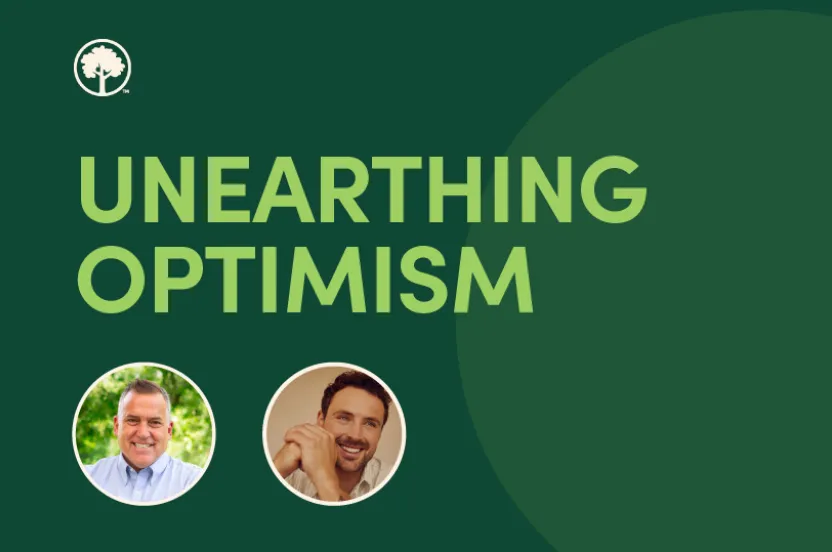
Hank Green joins Dan Lambe to talk science, optimism, and how everyday choices can help shape a better future for people and the planet.
July 20, 2026
Listen to this episode of Unearthing Optimism on Spotify, Apple Music, and Amazon Music or any other podcast platform.
In this episode of Unearthing Optimism, host Dan Lambe welcomes science communicator and content creator Hank Green for an energizing conversation about the power of curiosity, community, and sustainability. Together, they explore the significance of the Internet in the environmental movement and what meaningful engagement can look like.
Hank also shares the story behind Good Store, a values-driven marketplace turning everyday purchases into global impact. Plus, he talks through the massive educational reach of Crash Course.
Listen now and share with a friend — because hope grows when we all get involved.
Full transcript below
[00:00:10] Dan Lambe:
Real stories, real change, rooted in the power of nature. You're listening to Unearthing Optimism from the Arbor Day Foundation.
[00:00:23] Dan Lambe:
Hi, I'm Dan Lambe. Today we're joined by someone whose work has shaped the way millions of people think about science, storytelling, and the world we share—Hank Green. As an entrepreneur, science communicator, and co-founder of the educational video company Complexly, Hank has spent his career making complicated ideas accessible and building communities around curiosity, empathy, and action.
[00:00:53] Dan Lambe:
For our conversation, we'll explore the internet's role in shaping environmental conversations and choosing hope in the face of negativity. Welcome to Unearthing Optimism. It's great to have you with us today.
[00:01:03] Hank Green:
Thank you. I'm very happy to be here.
[00:01:07] Dan Lambe:
We've got a lot to cover, but before we jump into your work today, I wanted to rewind to early Hank Green. Any childhood memories around nature that still stick with you? For me, one of my first wow moments was visiting the Rocky Mountains as a kid—coming from Nebraska, seeing those mountains, waterfalls, and forests was just breathtaking.
[00:01:49] Hank Green:
I do remember. There’s this human thing about being in nature that’s just wow. I remember running around in the forest with my brother, racing along a fallen tree trunk. You had to keep your feet off the ground while dodging branches. He always beat me—if he didn’t, he changed the rules. It felt dangerous but safe, like you could always grab something if you fell. It made me feel capable. Plus, just running around in the woods as a kid felt amazing, even if you got ticks.
[00:02:37] Dan Lambe:
Wish we had more of that. But yeah, less ticks would be nice.
[00:02:43] Hank Green:
Definitely less ticks. Another memory was being outside on a cold night alone around age 12 or 13, looking up at the sky. It hit me—this is so much bigger than me. That feeling of weight and lift all at once.
[00:03:11] Dan Lambe:
You grew up with a dad working at the Nature Conservancy and the Arbor Day Foundation. We know the Conservancy well—we’ve planted trees with them worldwide for decades. Did that shape your view of nature growing up? Was it scientific, practical, emotional? How did your parents talk about it?
[00:03:42] Hank Green:
There was a mix. My mom worked at a sustainability organization too, so I got lucky hearing all sides. The conversations were like most families—they stressed morality: don’t waste water, electricity, or produce so much trash. Everything has an impact. I see that in my nine-year-old son now, growing up in Montana—a place with lots of wood but also a strong wood industry. We talk about how cutting trees isn’t just bad; there are sustainable ways to harvest timber. It’s not all black and white.
[00:05:13] Dan Lambe:
Exactly. Managed forests can be some of the healthiest.
[00:05:24] Hank Green:
Yeah, and my dad would sometimes drag me out to see scientists in the field. At first, it was a chore, but then I got it. Seeing scientists counting gopher tortoise holes—not the lab coat stuff—is valuable. It showed me science is everyday work, not just what you see on TV.
[00:06:12] Dan Lambe:
Now you’re one of the most influential science communicators around. It’s impressive. Watching your videos over the years, was there a moment you said, “I’m committing to being online,” or did it just unfold?
[00:06:37] Hank Green:
There was never a clear moment. I’ve always been drawn to two things: technology and culture. Technology feels like the real way to change the world—even if it’s frustratingly slow. Like how coal became economically unviable because better power tech came along. And culture—groups creating their own worlds—was never better than the early internet, where weirdos found their place.
[00:08:21] Dan Lambe:
So was it community that pulled you in, curiosity, or just fun?
[00:08:39] Hank Green:
All of those, but also people paid attention. That felt good. Community felt special. And it felt like we were at the start of something huge—like being around for the invention of radio or “I Love Lucy.” I don’t know if we should take credit, but it felt right.
[00:10:23] Dan Lambe:
Could you have imagined the massive visibility you have now, with millions tuning in?
[00:10:32] Hank Green:
No, and it’s a little terrifying. Sometimes I want to pull back. My wife says that too. But I always wanted to make for an audience. I evolve with feedback—it’s how I get better.
[00:11:15] Dan Lambe:
Your humility is real. You’re not always right, but you’re trying to be helpful. I told folks in our office, and teachers at NYU say you inspired them to get into science. That must be a lot of pressure.
[00:12:04] Hank Green:
Don’t worry, I’m already stressed! But yes, there’s a fear I’ll mess up somehow or misapply my limited hours. Some creators just chase views to get more views, like chasing money. I want approval too—like you saying nice things fills the hole a bit. But mostly, I want to focus on education because that has the biggest impact. Though I just can’t stick to it.
[00:14:02] Dan Lambe:
You’re gifted at breaking down complex info in a way that’s engaging yet rigorous. How do you approach that?
[00:14:32] Hank Green:
It’s a puzzle. When I can’t explain something well, I treat it like a puzzle to solve. It’s rewarding. I don’t get jealous of people doing better work; I want to learn from them, be their friend. I try to remember how my brain understood it—that helps me explain it to others.
[00:16:20] Dan Lambe:
You’re piecing the puzzle for a lot of people. You even wrote a master’s thesis on technology’s role in the environmental movement. No offense, I didn’t read the whole thing.
[00:16:40] Hank Green:
Huge relief!
[00:16:44] Dan Lambe:
There’s a line I love: “The people who aren’t very interested are the most important part of the environmental movement. When the movement brings ideas to them and helps them realize they’re affected, that’s when it has the most strength.” Twenty years later, with social media and all, do you still think that’s true?
[00:17:26] Hank Green:
Absolutely. That’s the best line. I was a bit naive about the internet’s path, but still right to focus on engagement. The power is with those paying a little attention, not the fully converted. And it’s important not to alienate people who aren’t thinking about these issues—like my barber who loves his lifted truck and never thinks about global warming. We need to create open ways for people to connect, even though the internet pushes us into silos.
[00:18:42] Dan Lambe:
Has anything surprised you about how people respond to science content over the years?
[00:19:00] Hank Green:
Not really surprising, but I’ve learned a lot. The main reason people engage is curiosity. They want to know true things about the world. Though some, especially young men, start out wanting to know facts to feel superior. I try to lead them from that to the joy of truly learning something amazing.
[00:20:07] Dan Lambe:
Let’s talk about The Good Store. I’m a huge fan—I just bought some tea there. It’s a great example of how individual choices can make a difference. People get frustrated about climate and sustainability now—like their actions don’t matter. What inspired you to start The Good Store?
[00:20:49] Hank Green:
It’s good.store, an online shop with eco-friendly products—cleaning supplies, coffee, soap, socks, underwear. The idea is to run a store where profits don’t go to owners but to causes making the world better. My brother and I partnered with Partners In Health, a great group building healthcare in places with high maternal mortality or curable diseases. Foolishly, we promised to raise $25 million in five years. We tried lots of ideas; some failed, but Good Store took off. We figured if people are buying stuff anyway, why not buy it in a way that shares profits with employees and donates the rest?
[00:22:43] Dan Lambe:
Over $11 million so far—impressive. Is there a product you’re most proud of, not for sales, but impact?
[00:23:10] Hank Green:
The Awesome Socks Club started it all. It’s a monthly sock subscription featuring designs by independent artists. Your feet become a canvas, but you don’t know the design in advance—it’s a surprise. People love it, buy for friends, and gift extra pairs. It’s got a great vibe.
[00:23:49] Dan Lambe:
You’re big on sustainability. Got a personal habit you’re unreasonably proud of?
[00:24:02] Hank Green:
Absolutely. Food, especially agriculture, matters a lot for climate. Beef is very inefficient. So, my brother and I have “beef days”—four days a year when we can have beef. It’s not about condemning beef but about scaling back. It’s almost a 100% reduction from eating beef daily. Plus, it’s a ritual—something to celebrate. Like a hamburger on vacation or a special occasion. You get to pick your beef days.
[00:25:43] Dan Lambe:
Do you text each other about upcoming beef days?
[00:25:49] Hank Green:
Sometimes I hear about John’s beef days.
[00:25:51] Dan Lambe:
Awesome. So, looking back, what are you most proud of in your career so far
[00:26:02] Hank Green:
Crash Course is definitely the thing I’m most proud of. it was John's idea, but I didn’t...
[26:12] Dan Lambe:
Tell our listeners more about it.
[26:14] Hank Green:
Yeah. Crash Course is a YouTube channel focused on creating content meant to be used in educational systems. So instead of making a video like, "Hey, frogs are weird," which might be educational and you’d learn something cool, Crash Course is more like a full intro-level biology course with 50 episodes. People sometimes watch the whole thing, but often teachers assign individual videos to students studying for exams or needing extra help. It’s been ridiculously impactful. I get stopped everywhere by people saying, "Thanks to your anatomy and physiology course, I’m now a nurse, a paramedic, or a doctor." That course especially seems to help people on career paths, but I also get thanks for philosophy courses that helped people deepen their understanding of the world or psychology courses used in degrees. I hosted some courses—chemistry and biology are very popular—and now we have many hosts tackling a wide range of topics. It’s just out there doing good, and it’s free.
[27:44] Hank Green:
Educational media is such a messy, bureaucratic world. Just saying "selling educational media to schools" makes me want to run into a glacier and die. I’d never want to do that. But we got around it by competing with big, high-margin corporations by making the product really good and free. That was the only way. Instead of sales pitches to school boards over dinner, we let students tell teachers and teachers tell administrators. I love that. I never imagined it would work, but it has.
[28:47] Dan Lambe:
You said two things: it has to be free and it has to be good. And you nailed both. At the Arbor Day Foundation, we’re always looking for ways to engage youth, whether through schools or parents. It’s tough to break into education communities, so what you’ve done is really impressive. Congratulations.
[29:18] Dan Lambe:
This podcast is called Unearthing Optimism. The climate situation can feel dire sometimes, and some of your videos get heavy on that too. But at the Arbor Day Foundation, we see tons of momentum and hope through communities planting trees and disaster recovery. What gives you hope right now when you look at the climate and the planet?
[29:56] Hank Green:
The big thing is that we know it’s possible. For a long time, economies grew only if environmental harm grew too. But now we’ve seen economies grow while environmental impact shrinks. It’s counterintuitive but true. My lifestyle—having a fridge, hot water, visiting family—is something I don’t want to give up. People’s needs increase as economies grow, but eventually, they peak and environmental damage starts to fall because we get more efficient. We use less land to produce the same food, burn less wood and coal in homes. More development doesn’t mean more pollution automatically. Across countries, as basic needs are met, child mortality falls, women get more education, energy gets reliable, and governments stabilize, environmental impacts like deforestation actually drop. In the U.S., we’re reforesting, though we lost a lot already. It’s because people care and their needs are met.
[31:56] Hank Green:
We have to be careful not to just keep expanding what we consider needs and consume endlessly. But there is a path. I care about people not living in poverty and thriving. It seems like it’s either less environmental impact or more suffering, but actually, those can happen together. When basic needs are met, people want to protect their environment. Nobody wants to destroy what they live in. Empathy grows beyond just themselves. That’s what you do with Good Store and what the Arbor Day Foundation does—serving the same goal.
[33:00] Dan Lambe:
Exactly. Before we wrap, I have to ask—any favorite tree story? Maybe a forest walk, planting story, or just a favorite tree?
[33:29] Hank Green:
Picking a favorite tree story is tough—there are so many good ones. Favorite species? Maybe Ponderosa pine. They smell amazing—like caramel and vanilla mixed with Coca-Cola and coffee. If they made candy out of that smell, I’d eat it. We should get that into the Good Store.
[34:05] Hank Green:
As for a specific tree, I love my cherry tree—I take good care of it and use the cherries in lots of things. But the first thing I think of are the big oaks in the middle of nowhere that just grow wild. They send roots down and then back up, turning into sprawling oak complexes. I remember climbing those trees as a kid with other kids—the bark gets smooth from all the climbing. That’s my favorite tree feeling.
[34:46] Dan Lambe:
That’s awesome, Hank. Thanks for all you do. You clearly feel the responsibility and pressure, but the humility and integrity you bring to your work is inspiring. You help people pay attention to science, nature, and how they can be part of solutions. That’s a big deal. Thanks for being part of Unearthing Optimism.
[35:14] Hank Green:
Thank you. And thanks for the important work you do too.
[35:17] Dan Lambe:
That’s all for this episode. Hank’s perspective reminds us that real change starts with everyday choices—choosing optimism even when it’s hard—and believing collective action happens one person at a time. Thanks for tuning in to Unearthing Optimism. If today’s episode inspired you, please subscribe, leave a review, and share it with a friend. Until next time, keep planting those seeds of hope.