New on Unearthing Optimism: Growing resilient communities starts with trees. LISTEN NOW

Podcast: Building Greener Cities and Cooler Communities with
Dr. Vivek Shandas
Dr. Vivek Shandas explores how communities can use nature, science, and togetherness to tackle extreme heat and build resilience.
June 15, 2026
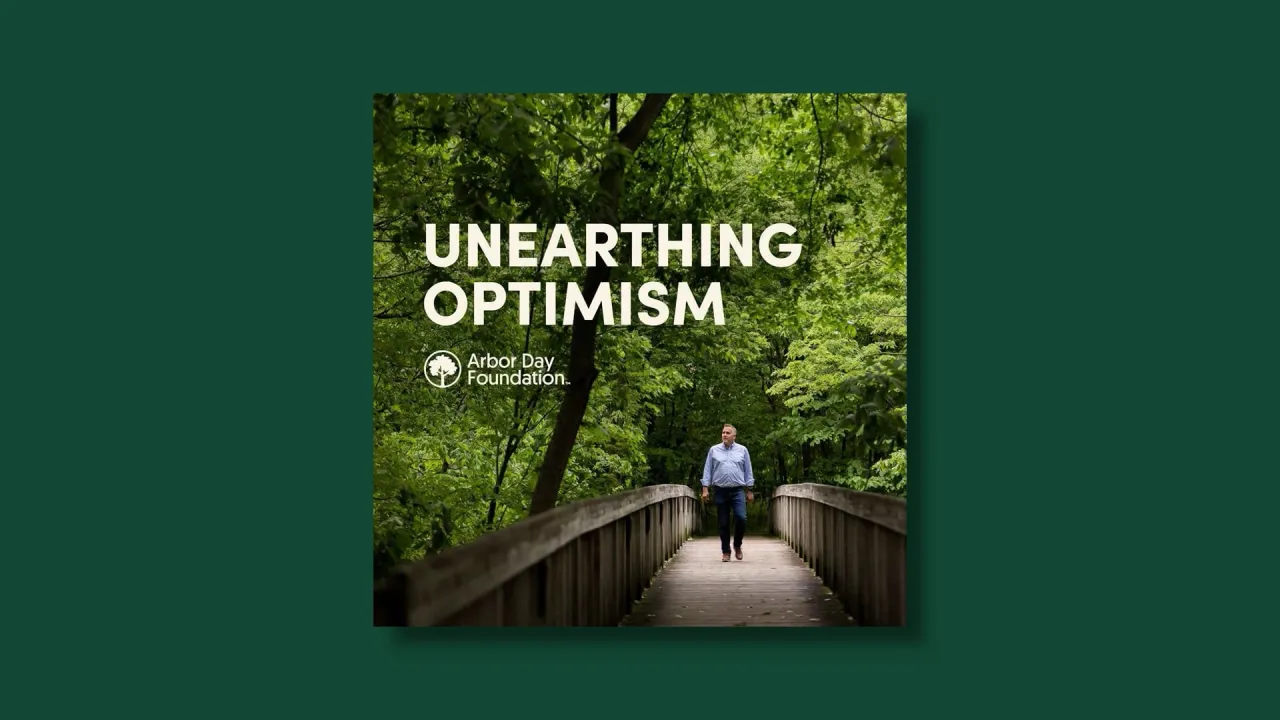
Listen to this episode of Unearthing Optimism on Spotify, Apple Music, and Amazon Music or any other podcast platform.
In this episode of Unearthing Optimism, host Dan Lambe sits down with climate resilience expert Dr. Vivek Shandas to dig into the urgent issue of extreme heat in U.S. cities—and the hope found in community-driven solutions. From the science behind urban heat islands, to real-life stories of neighbors coming together in the face of record-breaking heatwaves, this episode explores why trees matter for our health, well-being, and sense of connection.
Join us for an optimistic conversation packed with ideas for how trees and teamwork can help communities reduce extreme heat. Listen to this episode and share it with someone who cares about building a better, cooler future.
Full transcript below
Dan Lambe [00:05]: Real stories, real change, rooted in the power of nature. You're listening to "Unearthing Optimism" from the Arbor Day Foundation.
Dan Lambe [00:23]: Hi, I'm Dan Lambe. Today we're joined by Dr. Vivek Shandas, a leading expert on extreme heat and its impact. Dr. Shandas is a professor who has spent years helping communities understand and adapt to the effects of a changing planet. Through his research, he's developed a keen understanding of how nature can help us grow resilience in neighborhoods across the country.
Dan Lambe [00:48]: In this episode, we'll talk about what it takes to build communities that can stand up to the heat and where we can find hope as we face growing challenges. Well, Vivek, welcome to "Unearthing Optimism." I'm excited to be with you today.
Dr. Vivek Shandas [01:01]: Oh, I'm great to be here, Dan. Thanks a lot.
Dan Lambe [01:03]: Yeah. Well, I know we have gotten to know each other over the years. We have crossed paths at a number of different conferences. Anytime I'm at a conference and I see that Vivek Shandas is on the agenda, I try and get into that session if I can find a seat in that session. But I'm excited to visit with you today, but I'd love to just dive in first with a little bit about you. And I know you are in Portland, and I know Portland is one of these amazing cities surrounded by beautiful forests, rivers, pretty close to just some magnificent coastlines. And I'm wondering how much being in the Portland area has played a role in your relationship with nature.
Dr. Vivek Shandas [01:46]: Wonderful question, Dan. I really appreciate being here, having a chance to connect with you in this way, which is new for me, and I have really also adored getting to know your team. It's incredible. I've met with several of the team members at Arbor Day, and so a real privilege, honor to be here with you.
Vivek Shandas [02:04]:
To my worldview of how I see the connection between nature and cities, which has been a longstanding area of my interest. As I was coming into my professional world of thinking about what I wanted to do in the world, and when I asked my dad in college, he said to me...
I was thinking, "Oh, I want to do biology. Do I want to do sociology, religious studies? Where do I want to go with my..." And he patiently listened to me and said, "Well, it doesn't really matter what you pick. All paths lead to administration." So I sat there with that for a little bit, not knowing what he really meant by it, and now I see the wisdom of his words many years later and spending a lot of time in administration now.
But Portland, as I was thinking about all the things, I never thought I would be in Portland, I'll just say. I didn't really know what I was going to do. I didn't know where I was going to be. Though after I graduated from my undergrad, I came up to Portland to teach outdoor school to sixth graders. That was my first moment of recognizing that all the ecology training that I had as an undergraduate in California, I didn't really put into practice. And this was my first opportunity to actually translate some of these broader ecological concepts like macroinvertebrates and streams and how they could provide us some indication of the quality of that stream, thinking about photosynthesis, thinking about chlorophyll in trees, and working with sixth graders.
Oregon requires sixth graders to go to outdoor school to actually learn about this stuff. So very early on, this region of the country really helped me understand that there was such a deep ecosystem that we're just really starting to understand and making some sense of. And with kids at my side, it was one of the best ways to get familiar with the local area.
Dan Lambe [04:00]:
And that probably also helped train you on how to simplify your communications. You talk about some really heady stuff, some real science-y stuff, but working with kids was probably a part of what made you such a good communicator so people can understand the science you're talking about.
Vivek Shandas [04:12]:
Oh, I love working with kids. Even to this day, I do a camp every summer with my son. We go down into the redwoods of Northern California, and I literally have the kids smell the soil that we dig up around the trees. They all think I'm nuts because I'm essentially going around and talking about the little insects and microorganisms in the ground and what they do for our air and our health and our well-being, and I think working with kids has just been one of the most inspiring aspects of my life, and it allows me to see the world in a whole new way. And bringing ecology to kids, which I think is getting squeezed out as we get more and more urbanized and more and more into our cities where there's the real challenge of getting kids into connecting with nature as easily. It's really a place of inspiration. So yeah, translating this kind of stuff to kids is really where a lot of this was born.
Dan Lambe [05:08]:
I didn't know that you had done so much work with children and education, but as I was prepping for this, we found some of the information and the curriculum that you had built for the Children's Discovery Museum and the BIO SITE curriculum.
Vivek Shandas [05:19]:
After coming to Oregon as a seasonal job taking kids out in the woods, I needed something to do during the off-season, and I was lucky enough to work for the Children's Discovery Museum of San Jose, California, where there was a National Science Foundation project called BIO SITE, and it's students investigating their environment. That's the site. And it was a wonderful program where these are urban kids that have rarely been around nature, getting them in front of a stream, testing the turbidity of streams, looking at what the pH of streams is, and talking science in a very accessible way and trying to get them to think about the role that this Guadalupe River, which was right in the backyard of the museum, played in their lives.
We offered opportunities to see the bird life, see the little insects, talk about the trees, and really find a way to get the students who had been there their whole lives to see the place in an entirely different way. And that was the part of it when a child would just look at you and be like, "Wait, this kingfisher has been here all along, and that's the sound I hear when I'm walking to school in the morning? I had no idea." Like that moment, magic.
Dan Lambe [06:24]:
That's great. That's really cool. Well, I'll tell you, I'm more familiar with your research into extreme heat, and we're going to talk a lot about that. But I know some of your most recent research, you have found that about 72% of US cities are losing greenery, green space, tree canopy. Just talk to us a little bit about why that's such an urgent issue.
Vivek Shandas [06:48]:
So one of the things that I've come to see over the years is simply that our cities are getting hotter. Like they're just simply getting hotter over time. We've been monitoring this for decades, and we actually have a really good signal from the urban heat island. That's essentially when cities get hotter than their surrounding areas. And in North America, that is a phenomenon well documented going back to the 1800s. And we have now learned that this heat, that as it's going up, one of the primary ways to reduce that heat is providing shade. Not only shade for us as we're walking on sidewalks, though also shade in terms of the infrastructure that's on the city streets, on houses and driveways and all these areas we live, work, and walk.
And part of the piece there is that we have been observing that as we've looked at 33 cities across the country, we saw that consistently that they were losing tree canopy cover over the last decade. And this was unequivocal. It was a pattern, again, that you can't unsee, and it was an attempt to try to understand not necessarily why it was happening, but what was happening in terms of tree canopy in different neighborhoods. And we're finding that that tree canopy was being lost not equally across the city, but some areas of city were losing tree canopy much faster than other areas of cities. And that's, again, something that's kind of salt on a wound in a warming urban environment.
Dan Lambe [08:19]:
Let's dig into that a little bit because not all neighborhoods experience heat in the exact same way. As you mentioned, there are a number of communities that are lacking tree canopy. They're underserved communities, and you've probably seen that firsthand in some of your research. Can you share any of those real-life examples of what that looks like and feels like at the community level?
Vivek Shandas [08:47]:
Yeah, absolutely. I live in a community that has historically had very few trees living in it. I live in Northeast Portland, an area that was historically African American, Black community, mainly a lot of labor, blue-collar workers building ships. Portland, known for its port, has a long history of building ships, and so a lot of the employment that was happening would be African American communities that were very concentrated in this part of Portland, Northeast Portland, and it had very few trees in the past. And that goes back to a whole set of research we did that was published in 2020, and that later a few other iterations of it came out, essentially showing that certain planning decisions that were made across the city really put trees in some neighborhoods and didn't put them in other neighborhoods.
And so when I walk around this neighborhood that was historically disinvested and wasn't highly green spaced or treed, you can feel it on your skin. And when I talk to communities around the country, I was just in recently the Southwest, and as I was walking around parts of Las Vegas, we were talking about what are the areas that were more invested and less invested, and the pattern holds out today, and we see that there are smaller trees, less diverse trees, and a lot generally less canopy shading the streets and the sidewalks in these historically disinvested communities. And so it's a very palpable and measurable, as we've found, outcome of decades of disinvestment into certain parts of cities that now we see the communities are often struggling with trying to stay cool during these hotter temperatures. And so many, many anecdotes like that, whether it's Jackson, Mississippi, where we've spent a lot of time, Atlanta, Detroit, even booming places like Chicago, Seattle, there's still that same pattern that's holding out.
Dan Lambe [10:48]:
We know that the last 11 years have been the hottest years on record, and you have been studying heat for a long time. I think for 20-plus years you've been studying this. We've all felt it, doesn't matter where we're living across the globe, not just the United States. We are breaking heat records. The trend is continuing, and it still can feel a little bit abstract to folks, even if they're feeling it. And I'm curious how you have found ways to talk about this issue that helps to put it in perspective for folks to help them understand that it isn't just about them and their experience, but how this is an issue that is affecting a much broader community and population.
Vivek Shandas [11:42]:
It's a really interesting, important part of this journey of trying to engage more people in this work, and I feel like that's been a large part of the translation work that I've been involved in is trying to bring this out to more communities. And the number one thing that you have to do when you're trying to talk about anything with anybody is make it relatable. That is something that I have found to be true over and over. If I'm talking about 1.5 degrees Celsius—doesn't make much sense to most people. If I'm talking about census tract 8,321, doesn't make much sense to anyone. I want to get it down to under their nose, on their skin. I wanted to get it to as immediate to their daily environment as possible. I call it the ecology of everyday life, right? The idea that you're really encountering so many things as you're going, whether to work, to school, whether you're going to worship, whether you're going to play with friends, whatever your activity is, you're always in some way interacting with the ambient environment.
And so what we want to do is just ask from their everyday perspective, the approach we take is often kind of how does it feel on a summer day when you're going shopping in a parking lot, and you're driving to a parking lot, or you're walking through a parking lot, you're biking to a parking lot. How does that feel for you? What do you feel on a day-to-day basis in your home? Is it hot? Is it uncomfortable? Are you able to sleep? Some real basic things, everyday life type stuff. And that starts this relatable conversation of saying, "Wow, I remember growing up in this place, and I don't ever remember it hitting over 100 degrees," or, "I don't ever remember it hitting over 110 degrees." And lo and behold, we're starting to see these thresholds broken and these records broken every year on year.
And as a result, I can take these kind of ideas, concepts, responses from communities and start saying, "Well, what do you do? How do you reduce that? What are options that you feel like you have in front of you and don't have in front of you? What do you think other people are doing?" This kind of curious mindset of just evoking some conversations like you're doing with me here in terms of asking questions and conversation. I find that to be incredibly valuable way to relate and connect with people, and approach most of my engagements in that way.
Dan Lambe [13:58]:
I've seen it, and you're gifted at it, Vivek. You are able to connect that research and science side to that human, just conversational side, and it is a really important part of us being able to bring a broader audience into some of the conversations.
Vivek Shandas [14:14]:
Yeah, appreciate that, Dan. Thanks. Yeah, it's never the same twice.
Dan Lambe [14:19]:
Well, I know that you've studied a lot of heat, but it's also been personal for you. Back in 2021, the heat dome came across the northwestern part of the United States and settled into the Pacific Northwest, including Portland, for a long period of time, with record temperatures trapped over the region, and it must have felt like you were living in a natural disaster in a lot of ways. How did you see the community come together during that time? What was the community's reaction?
Vivek Shandas [14:52]:
I want to get to that community piece. I'll just quickly say that heat is not recognized as a natural hazard or disaster by FEMA standards, Federal Emergency Management Administration, or many other agencies, even locally. Heat is just kind of left untouched, and so no one, quote, "owns heat" in a local setting. And so it really becomes the onus largely falls then on the community.
And so your question about how do you see communities coming together, it's almost like there's no other option right now. There's not the option that there is federal money that's going to show up to help with this natural hazard because it's not considered a natural disaster. Local folks don't own it. There's often very few heat offices. There's a couple that are emerging. And so when communities are left without any real direction, it's a coming together result, right? And so what I've seen is just probably one of the more kind of hopeful and optimistic aspects, connecting to the podcast here, more hopeful and optimistic aspects of this work is that, wow, there's not much resources to help us, so how can we help each other?
And so what I've seen is incredibly small gestures to relatively large gestures. I've seen private foundations and various other groups show up with large donations for heat pumps and cooling shelters and creating these kind of resilience hubs in buildings so that people during heat waves can show up there. I've seen very small gestures, like during the heat dome and subsequent heat waves, I saw little ice coolers that were put out on people's front yards with water bottles in ice that were set out, and there was a little sign there that said, "Please take the water, leave the cooler." Right? And these real simple gestures. And I saw neighborhood residents setting up tables with misters, like little misters. They took their hose and created a little misting thing and had chairs set up, and so suddenly it was people coming together.
There's a really large, beautiful tree in the neighborhood. It's one of these sequoias, one of these gorgeous 150, maybe 180, I haven't dated it, sequoias. Large groups, like the local childcare facility that didn't have air conditioning, they're going underneath this tree and gathering underneath the tree and doing their songs and games, and et cetera, during the hot days, weekdays. And there's so many of these little kind of gestures that I'm picking up on. These gestures, regardless of whether they're big or small, does not meet the scale of the need right now. I'm pretty convinced about that. Though seeing it itself is very heartening, and knowing that there are people looking out for one another is one of the best parts of doing this work.
Dan Lambe [17:46]:
I'm sure we see that all the time in natural disasters. Even if it's not classified that way, it must have felt that way, and there were a lot of tragic deaths during that heat dome as well. I mentioned it was personal for you. Even to go even a little further personal, I saw and heard an interview that you did with your, at the time, 11-year-old son about the heat dome. And it was really cool. For someone who has studied this for a long time, it must have been interesting to hear his reactions to it and hear his experiences, and I'm just curious if living through that, hearing his perspective changed your thinking or reaffirmed your commitment to the research.
Vivek Shandas [18:29]:
I talked to him so much about this, and he told me recently, he's now 16, and he's coming of age, so to speak, and he's telling me, "There's a lot of stuff that we talk about that is pretty hard to directly look in the face." Like the hotter temperatures we're talking about here, we're hearing about some communities really struggling with it.
And so his approach to it is largely around, let's find innovative, clever, artistic ways sometimes to engage people. We've been doing a lot of drawing together. We've been doing a lot of non-traditional conversations about science from your dad. It's not like we're doing that anymore. We're doing a lot more ways to think about creative efforts of art and poetry and music to be able to bring that into the conversation. And I think his experience with this throughout his life has really brought to him a recognition that we need to be finding many different ways to address this. My dad's got the science angle. That's cool. Let him go with that. I want to find some other way to do it, so I'm really trying to encourage these multiple ways of knowing about this phenomenon, and science is but one way to really know about it, and engagement can take so many different forms.
And so I think through his music and through various ways that he's thinking about this, it's going to be much more real. We don't have air conditioning in our home, and in the heat dome, we got a window unit, because I was looking at it 10 days before thinking, "There is no way it's going to be 110." But lo and behold, it was even hotter than that.
And we got a window unit all huddled with both dogs, my spouse, my son, and two dogs all huddled in our bedroom basically for three days together and just did the best we could, checked in on our neighbors and friends and colleagues and family. And he's really one of those folks who I think is going to be part of a generation that sees this as an everyday reality and is going to find the most clever and sometimes not conventional ways to engage people and understand the phenomenon.
Dan Lambe [20:32]:
Well, I know when I get to see you at conferences, Vivek, you're not talking just about the problem, you're talking about solutions. And that's one of the things we always love about you is you're not just pointing fingers at everybody else, pointing out what's wrong. You're helping to bring answers to the table.
There's some big challenges you're seeing. Some of the research you're coming up with isn't really always the most happy result. So where are you seeing hope? What's giving you that sense of optimism in the communities you get to work with, the lessons you're learning around the country and around the globe?
Vivek Shandas [20:59]:
I will say that the solutions are a big part of it, and not only do I draw inspiration from these solutions, but in any time there is a solution, the thing that I find most consistent through all of these solutions is the coming together of people around the problem. I just happen to think that getting trees planted in the ground is probably one of the most phenomenal ways to bring people together. But that aside, regardless of the kind of challenge we're facing, every situation will have a different coming together of people.
I mean, outside of natural hazards, if it's something related to somebody being evicted from their home, it's a coming together of people. If it's something related to a tree that has caused some damage in some place on a sidewalk or something else, it could be people coming together to try to solve a problem, if it's a traffic accident, et cetera. So whatever the condition, whether small or large, it's this coming together of people.
And in my mind, the most, I think, interesting aspect of that is that when people come together, there are new ideas that are born, there are new partnerships that are made, and there's potentially new and different ways of approaching the same problem. Mutual aid networks, when it comes to heat, have been an incredible novel recent development where people are looking out for each other and helping each other out through a small network of people that are often at the city block scale or even at the local community center scale. That kind of coming together is probably one of the more, I think, necessary solutions that we're talking about.
And time that feels, I don't know, just to go out on a limb here, in a time that feels remarkably divided among whether it be your particular persuasions of politics or whether it be your particular flavors of ice cream or whatever it is, it's like there's a divisiveness in the air that I feel like the best way to counteract that is just the relatability and the coming together of folks to talk about what they see as the problem in their view and grounding it in the values that we all share together.
Dan Lambe [23:18]:
Yeah. I'm glad you see it. We see it as well. We see it a lot of times through planting trees, as you know. And that togetherness, one of the things we say at the Arbor Day Foundation a lot is that trees bring people together to do great things. And it does connect cultures, it connects neighbors, trees connect communities, and they do help to create healthier, cooler, safer communities.
And that's part of where some of our optimism comes from in this space as well. Vivek, I know another part of what gives us a lot of optimism is the fact that more and more communities are tuning into research like yours and recognizing, whether it's part of their climate action plan or their urban forestry plans, that trees can be a part of this solution for extreme heat. I was at the COP in Dubai a couple of years ago, and there were loads of city leaders there, mayors and other city leaders embracing nature-based solutions to some of the biggest challenges facing them today. Do you feel that? Do you feel more and more cities are listening to this kind of research and looking for answers like trees and other nature-based solutions?
Vivek Shandas [24:28]:
Not only do I feel that there's a big shift happening in broader society around the recognition of nature-based solutions, as they're often called, we're also starting to quantify a lot of these because they appreciate over time.
Nature has an amazing resiliency to it that allows it to grow and establish and actually help us fundamentally in this idea of ecosystem service. And I can tell you that there are quantifiable reductions in healthcare costs, there are quantifiable reductions in general health and wellbeing. And when a natural hazard hits, think about, we're talking about heat, a natural hazard hits, a community that has trees around it often has a little bit more wherewithal. There's some recent research coming out about the psychological benefits of having trees around you, and that you actually have greater adaptation potential as a result of being closer to the forests and the trees around.
And as a result, when a heat wave hits, you actually can adapt a little bit more effectively than someone in a concrete jungle. Right? And so these subtle but I think significant ways that I think larger communities are seeing the benefits of trees is a palpable, measurable, and I think definitely emotive way of taking action on this.
Dan Lambe [25:48]:
So Vivek, I know you see a lot of programs, you see a lot of projects, you've seen a lot of examples of systems approaches, and you get to work with a lot of different organizations and individuals. And I saw one place where you said one of the best parts of your work is collaborating across teams.
And I wonder if you could just share with our listeners, what does that mean to you? How do partnerships shape our abilities to make a difference, to create change?
Vivek Shandas [26:19]:
Well, we're not going to be doing this alone. We are going to try, even planting a tree, I need someone to hold up that stem as I'm trying to get the hole just right to get the tree ball in. And anything that I do, and everything that I do, I find that we are better when we get some, at the basic level, a sounding board to be able to reflect back to us.
And then you take that at the partnership level on the larger scale, and if we want to move bigger things like the Arbor Day Foundation is doing, or many other communities are doing to try to actually safeguard communities from extreme heat and other hazards, doing it alone is very challenging.
One of the most amazing experiences I had, I know you've talked about Katrina, I was at a very similar event in South Asia where a big tsunami had hit in 2004, and it was remarkable to see the amount of coming together shortly after that. And in the fires that happened, we had massive fires in 2020 that were affecting lots of communities in the West Coast, and that was an outpouring of communities coming together. These were fire marshals talking to social workers, talking to public health researchers, and talking to folks who were at the front line of community-based organizations trying to find resources for the communities that had literally lost everything.
And so the human ability to come together when times of need show up has been really remarkable. And so for me, what it really comes down to is recognizing that we all share this space together. In fact, we breathe the same air. We are all connected in that way.
So what we need to do is identify the kinds of partnerships that'll help lift the collective up in a way that allows us all to benefit. Partnership is really about one plus one being three. That really is what it's about, and I don't think I'm saying anything new there, though in every context, I feel like it is a unique set of conditions that we have to lean on each other to try to understand and then identify what are the productive pathways forward for us to be able to lift all of us together, because it's going to take more than the village.
Dan Lambe [28:38]:
It's a great reminder. We know we are at our best when we're working with partners. It's a multiplier effect, as you talked about, and it's true. So thanks for just the reminder, if nothing else on that.
So I got a question for you, Vivek. You are an optimistic guy. You're covering some tough issues. Where does that come from for you? Where does that optimism come from? Where does that spirit of positivity originate for you?
Vivek Shandas [28:53]:
Oh, it's a very multi-layered question, Dan. I will go out on a limb. I will, of course, give so much credit to my parents who were so publicly oriented. I feel like I got my superpower of volunteering an enormous amount of my time, partly, of course, from my parents, who did exactly the same thing. So I cut from a cloth of civic service, I guess, is the way to put it, cultural and civic service. So that's in my bones. So that really gives me inspiration.
There is a part of this that's also getting up in the morning, right? Like the question of what gets you up in the morning. And for me, so much of this is just recognizing that every breath I take and every time the sun hits my skin is something that gives me some recognition that I am a small part of something much, much bigger.
I have some control, some agency in the very local environment that I have, but I am a part of something much bigger that I don't have words to even express. And so when you get to that level of recognizing your place in the bigger picture of what this entire manifestation is of trees and mountains and lakes and rivers and people and infrastructure and what have you, you're like, "Well, that is pretty magnificent when you really stare at it closely and spend a little time reflecting on it every day.
It brings me up and gets me motivated, and allows me to talk to and meet great people like you and the folks at the Arbor Day Foundation. And each interaction, there's always something there for me that gives me a little bit more hope and direction. Even the hard ones. If you look closely, even the hard interactions will often provide a little bit of grist for us to think about, reflect on, and I think ultimately grow and flourish as a result.
Dan Lambe [30:54]:
Yeah. You bring a lot of inspiration to others as well. You know, Vivek, when you talk to me, I'm going to be talking about trees. And so as we wind up this conversation, I'd love for you to share if there is a favorite tree story you might have that you can share. If there's a tree that you love, that you'd love to tell us about. Anything you could share with us?
Vivek Shandas [31:19]:
Oh, boy, Dan, this goes down into the roots, no pun intended. But I will just start with one of my earliest, fondest memories was I'm a younger brother of an older brother of six years who was not exactly the nicest. He doesn't mind me saying this, I don't think, but wasn't exactly the nicest of older brothers as I was growing up.
So I had a tree on the side of our house, actually, in South Asia, in India, in the town of Bangalore. There was a tree in the side of our house. It was a mango tree, and it was a beautiful, old mango tree. And I would often, just to get away from the stress of my older brother and maybe other things that were going on, this was my refuge. I would climb up this tree.
There was a third branch on the south side, when I think back on it now. That tree's long gone, by the way. All that has been developed into flats. But I recall fondly of having that as an option and figuring out how to use my hands and my legs and get up there, scramble up there, and sit up there and essentially then start holding the leaves of it. And learning later that indigenous people use the mango leaves to scrub their teeth, and it was helpful in terms of gum health and things like that for your dental hygiene, apparently.
And all of that aside, that's one of my earliest memories of having that tree as my refuge. And much later on, growing up in the redwoods of Northern California, there is a specific tree in Richardson Grove State Park, which is in Northern California, way up north, past Ukiah, and getting up into that near Oregon, California border. Beautiful area, and there is a magnificent, my guess is probably 2,500-year-old redwood there.
I got to know it first because I went by it with a group of kids after we'd cleared some trails, and I took my loppers, my big chop things, and I tapped it on the side just to say hello. And not knowing that there are a bunch of hornets that were in the bark of that, and getting stung after a fact, I quickly realized that I don't do that to redwood bark.
And then also found a fondness for that tree, some twisted way, but I go back to that tree every time because it was such a visceral memory of pain, but also a recognition that, hey, this is not something I can just go mess around with. These are long, historical ecosystems that have creatures living in them and don't want to be disrupted.
So I was trying to... I have that tree up there that I go back to every year and check in on and never tap again.
Dan Lambe [33:52]:
Lesson learned, right?
Vivek Shandas [33:53]:
Yeah.
Dan Lambe [33:55]:
Vivek, just thanks for the work you're doing. Honestly, thanks for your leadership. Thanks for being a champion of trees. We appreciate it. You're a skilled communicator and a skilled scientist, and we are grateful for having your optimism and hopefulness in this work. And I have appreciated our friendship, and I look for growing that friendship for years to come.
But thanks for joining us on Unearthing Optimism, and I can't wait to see you again sometime soon.
Vivek Shandas [34:21]:
Sounds great, Dan. It's been a total pleasure, and I'm always glad to be chatting with you.
Dan Lambe [34:26]:
That was Dr. Vivek Shandas, reminding us that even in the face of big challenges, small actions can make a real difference.
To our audience, thank you for tuning in to Unearthing Optimism, and if today's episode moved you or inspired you, we hope you'll subscribe, leave a review, and share the show with a friend. Until next time, keep planting those seeds of hope.