The AP’s Peter Prengaman talks news and hope in Unearthing Optimism. LISTEN NOW

Podcast: Connecting Culture, Comedy and Conservation with Rainn Wilson
Actor Rainn Wilson gets real — and funny — about environmental action, hope, and why trees can unite us all.
March 16, 2026
Listen to this episode of Unearthing Optimism on Spotify, Apple Music, and Amazon Music or any other podcast platform.
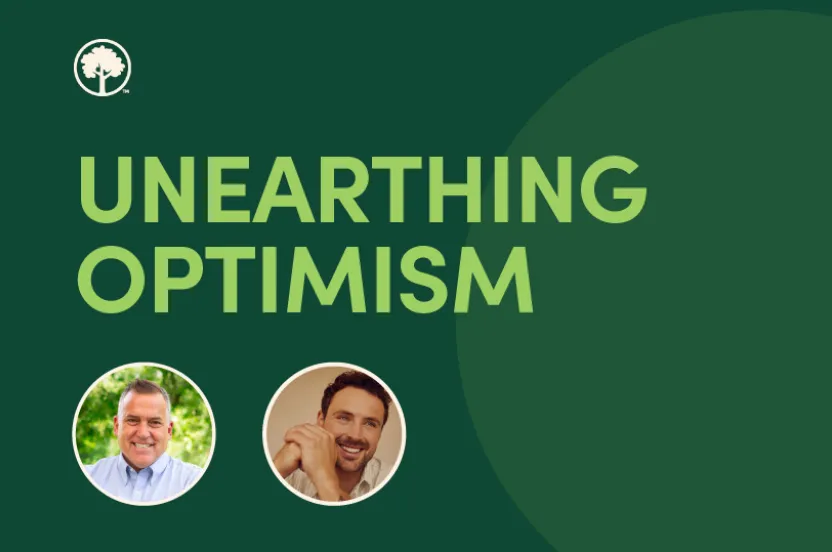
Host Dan Lambe is joined by acclaimed actor, writer, and passionate environmental advocate Rainn Wilson (best known as Dwight from The Office) for a funny and honest discussion connecting culture to conservation. The two dig into Rainn's journey from the forests of Seattle to comedy fame, and why he’s now focused on bringing inclusivity, humor, and heart to the climate conversation. Hear how spiritual revelations, multiple wildfire evacuations, and a love of trees have fueled Rainn’s advocacy — and why he thinks creative storytelling might just be the key to hope and action.
Discover personal stories, surprising connections, and actionable ways YOU can help create a thriving planet for generations to come. Want more optimism? Listen to this uplifting episode and share it with a friend.
Full transcript below
Dan Lambe [00:00:00]:
Hi, I'm Dan Lambe. Today we're joined by Rainn Wilson, actor, writer, producer, and passionate environmental advocate. While many people know him for his iconic roles on screen, Rainn is working to make the environmental movement more accessible, more human, and even funny. Through his organization, Climate Basecamp, Rainn is rethinking how we talk about the planet and the power of connecting culture to climate. Today, we'll explore why these efforts feel so personal to Rain. How humor can help shift public understanding and the importance of connecting with the planet. Rainn, welcome to Unearthing Optimism. It's great to have you with us today.
Rainn Wilson [00:00:43]:
Let's unearth some optimism, Dan.
Dan Lambe [00:00:46]:
So, Rain, we got a lot to cover with you, for sure. Want to talk about your climate communications work. Want to talk about how you're engaging in this debate, But I'd love to get to just know you a little bit better first. I am a big fan. You've got a lot of fans out there. But I think most people know you as an actor. I don't think a lot of people know you as this outdoor enthusiast or this champion of conservation. And I'm just curious to know what's it like for you in nature.
Dan Lambe [00:01:15]:
Do you love to get outdoors? Do you love to spend time outdoors? What's that look like for Rain?
Rainn Wilson [00:01:20]:
I am definitely an outdoor enthusiast. Am I an outdoors expert? No way. Not a chance. A good friend of mine I went to high school with in Seattle, Mike Wentzel. He was an Eagle Scout and he leads hiking and camping expeditions. He's the kind of guy can, you know, throw on a 50 pound pack and go out into the wilderness for 12 days and fight off bears and the whole thing. Sometimes I go out with him, but really it's about growing up in Seattle. And I'm so blessed to have grown up in the Pacific Northwest because out there, kind of everyone is an outdoor enthusiast.
Rainn Wilson [00:01:58]:
I mean, you've got Puget Sound right there. You can hop on a boat, you can go fishing. There's rivers and streams, there's salmon runs, there's old growth forests. You know, the North Cascades.
Rainn Wilson [00:02:12]:
And the Cascade Mountains, the Olympics. So I was always begging my parents for more camping, even if it was like kind of crappy car camping where we would drive our Ford Pinto to a campsite and then pitch a little, you know, aluminum pup tent.
Dan Lambe [00:02:29]:
You did a lot of camping growing up?
Rainn Wilson [00:02:31]:
Well, I always wanted to do more. We would do maybe one trip a year, but I always wanted to do more. I would beg my dad. He was not. He was. He was an indoor, and he was. He was more of the indoor type, not the outdoor type.
Dan Lambe [00:02:45]:
Well, I heard you grew up in the Seattle area. We've done a lot of work up in the Pacific Northwest. It is, without question, one of the most beautiful parts of the country, and it has to have impacted you as you've grown up. But I'll tell you, like you, I did some camping growing up as well, and I feel like those exposures to the outdoors, sometimes it's not till later in life that you actually pivot to actually wanting to protect them and be an advocate for them instead of just appreciating them. But I. I grew up. My parents. We didn't have a Pinto, but my parents had a station wagon, and they would load us four kids up and take us to state parks or national parks.
Dan Lambe [00:03:24]:
And my mom would be super intentional about making sure we're, like, looking at the beauty of nature and pausing. And, of course, we didn't have iPads to distract us at that time. And I don't think I really appreciated as much then. But now I end up working at the Arbor Day foundation, and I'm working hard to create that kind of beauty. And I'm curious, when did that kind of happen for you? Because you're an advocate now. When did that pivot happen for you, from just enjoying and appreciating to wanting to do something about it?
Rainn Wilson [00:03:57]:
That's a complicated and multifaceted question. Part of it has to do with my spiritual path that I have been on, and I won't go into it in great detail, but. But as I was kind of searching for God and meaning and purpose in my life, and as I was reading more and more about our Native American brothers and sisters and indigenous spiritual traditions, this kind of sinking realization. And I was living in Brooklyn at the time of all places, but this sinking realization happened that the divine and nature are inseparable. And that for hundreds of thousands of years since humanity's been walking the planet, there was not a distinction between, like, oh, here's God, faith, and religion over here, and here's nature over here.
Rainn Wilson [00:04:58]:
You know, so the divine, what is holy, what is sacred, is just known through nature, known through the seasons. It's known through beauty. It's known through the cycles of life and death.
Rainn Wilson [00:05:13]:
And from the very small insect on a flower to the totality of the cosmos in the night sky. And we were so, as a species, so interconnected with nature. This kind of was part of my realization that something missing from my spiritual path was a deeper Connection. So as I entered that and started, you know, you know, even just meditating outside or hiking more or visiting more, you know, beautiful national parks, realizing that I kind of experienced a divine movement inside and connection through nature. It wasn't something kind of separate from nature. I think a lot of times we. We build churches and kind of keep nature out for a good reason. We know we did that for a good reason.
Rainn Wilson [00:06:03]:
But maybe it's time to move out of the churches and back into the cathedral of trees.
Dan Lambe [00:06:09]:
Were you doing a lot of reading around that, or was it just kind of a self realization? I mean, you said you were in Brooklyn. There's some amazing parks and green space in Brooklyn. But were you a part of some conversations? Was it reading, or was it just kind of connecting with nature and having this self realization?
Rainn Wilson [00:06:28]:
It was a lot of reading. It was a lot of pondering. It was a lot of prayer and meditation. I went through some difficult mental health challenges, especially in my 20s. I've dealt with them throughout the decades, but especially in my 20s. That kept me kind of searching for something more.
Rainn Wilson [00:06:50]:
And I was reading a lot of holy texts. I was reading a lot about Buddhism. I read the Bible, and I started reading about indigenous faith practices. And I learned about this concept from the Lakota Sioux of Wakantanka. And the name is the name for God, and the name translates as the great mystery. And Wakantanka in this tradition is not really a being separate from nature. It's a being reflected through nature, whose power and beauty and majesty is reflected through nature. So I was like, I don't know if I believe in God, but I definitely can believe in Wakantanka.
Rainn Wilson [00:07:32]:
And that just helped me connect on a greater level. I'm thinking of the divine as something other than like an old white man with a beard on a cloud, you know, in the typical kind of Michelangelo perspective. And then fast forward to being a. I was a theater actor, then I was on film and tv, and then became a celebrity thanks to the Office. Thanks the Office. Thanks Office fans.
Rainn Wilson [00:07:57]:
And realized I had a voice. And it was important. And it was important for me to use my voice to try and make the world a better place. So I've been working with various nonprofits in various capacities, and the environment and climate is something I feel really passionate about, probably from my connection to being a wee blow.
Dan Lambe [00:08:17]:
That's as far as I got. That's as far as I got. Was we below as well. But I have great respect for everyone who made it all the way through to Eagle Scout. It is amazing and impressive. Well, I'm going to come back to some of that celebrity stuff and why you're doing this, but I do know that your engagement in and your approach to talking about the environment has changed. You self described yourself as a keyboard warrior back in the day, engaging in the conversation around climate. But you've described how you've evolved into a more inclusive way of communicating.
Dan Lambe [00:08:54]:
And I'm wondering if you can just share what that realization was and a little bit more about that evolution as a communicator in this space.
Rainn Wilson [00:09:02]:
Exactly. Like you said, one of the things that drove me crazy and drives me crazy is how the science of climate change has been politicized. And in fact, it's even hard to say the word climate these days because a lot of people have a really adverse reaction, which is so unfortunate because humans are affecting the climate. I mean, how could we not? We've been belching out, you know, CO2 and heat trapping gases for almost 200 years into the atmosphere. And that it just makes total sense. And it's, and it's backed up by science and test, you know, data point after data point. So now there's a lot of science deniers. And.
Rainn Wilson [00:09:49]:
Which also drives me crazy because science is just, science just exists. You can't like, pick and choose your science. Like, I'm going to, I'm going to believe in this science, I'm going to believe in gravity and electromagnetism, but I'm not going to believe in nuclear fission. And I'm not going to believe it. Like, you either take science or you just make up your own set of rules and follow that. But my first interactions around that work were kind of typical for early days of social media, on Twitter, kind of angry and debating. And I realized that this way was not a path forward. This wasn't doing any good.
Rainn Wilson [00:10:28]:
And, and that really, since I had a voice.
Rainn Wilson [00:10:32]:
That I needed to do something, you know, I needed to poop or get off the pot in a way and put my money where my mouth is. And so.
Rainn Wilson [00:10:44]:
That's when I started.
Rainn Wilson [00:10:47]:
Looking into climate and environmental causes a little more deeply. I came across a wonderful woman named Dr. Gail Whiteman. And she's a not only a climate scientist, but also a climate communicator. And she actually started in advertising. So she knows ways to deliver science and data points, you know, that, that are effective. Because what I learned, the first thing that I learned. Damn, Dan.
Rainn Wilson [00:11:10]:
Did I say damn, Dan? Damn you, Dan. Damn, Dan. The first thing that I learned was that most people working in the environment.
Rainn Wilson [00:11:21]:
Are always just preaching to the choir. So if they're making videos or making content or delivering messages, it's to people who already feel like them, or else they're in a fierce debate with kind of the opposite side and butting heads, and that's no good either. But there is a large audience in the middle. And this is what I love about your foundation, is.
Rainn Wilson [00:11:45]:
Everyone can get on board with planting trees. Everyone can get on board with clean air. This is something that unites us. We love trees, we love clean air. Let's just focus on that. Let's just. And how do we. How do we message that most effectively to a mass audience to.
Rainn Wilson [00:12:01]:
To people in Nebraska, you know, who might be confused about climate science because they're getting different data points coming in from different directions. We have to be really loving and patient with them and build bridges.
Rainn Wilson [00:12:13]:
That. That unite us.
Dan Lambe [00:12:14]:
I'm telling you, rain, that's how we feel. We feel we've got this unique opportunity through trees to be uniters, because trees are about the one thing that everyone can agree on, and we. We feel that responsibly. So I love that approach to how are we communicating in a more inclusive way? But I know, I know climate has been personal for you. Even I know you've had to. My understanding is you and your family have had to evacuate maybe four times in the last several years from wildfires. My wife even coincidentally sent me a video of you sharing damage to one of your homes because of fires. And that has to have an impact on your perspective in this whole debate.
Dan Lambe [00:13:01]:
Would you be willing to just kind of share how that has altered some of your perspective?
Rainn Wilson [00:13:06]:
I have, in the last five years, had four evacuations.
Rainn Wilson [00:13:14]:
The first evacuation was at our old house in Agora Hills, California, and that was the Woolsey fire. And that was 21, 22.
Rainn Wilson [00:13:25]:
And.
Rainn Wilson [00:13:27]:
Our house barely got saved, thanks to our industrious neighbors that sprayed our roof down with. With hoses, snuck back in past the fire fireman and the Codron and. And went in and sprayed down the house. Thank you, neighbors. And. And then we have a family cabin up in central Oregon, and we went up there. We had to evacuate that. It was about three years ago.
Rainn Wilson [00:13:54]:
And then our house here in Ventura county, there was a series of fires that hit up in Ventura before the big Palisades fire and before the Altadena fire. It was called the mountain fire. About 100 homes were lost. It didn't really make the news because it was fairly small and our neighbor's house right up the hill up here burned down. Our neighbor's house right down the hill here burned down completely. And we lost essentially big chunks of two and a half rooms. And it's been over a year now, and we're still, there's still workmen crawling around fixing it. We haven't moved in back into our bedroom.
Rainn Wilson [00:14:31]:
And then we took a nice vacation. We went back up to our family cabin this summer. We're like, oh, we're just gonna relax for two or three weeks up there. And we had another evacuation and the flames were less than a mile. We had to go crash at a friend's house. It was just awful. So, you know, in terms of fires, I've experienced them firsthand on a number of occasions and it's, I tell you, it's incredibly unsettling.
Rainn Wilson [00:15:00]:
It's, you know, when you're, when your home is threatened, there's a kind of a set of feelings and anxieties that are unlike anything I've felt before. It's very off putting.
Dan Lambe [00:15:13]:
I'm sorry you had to go through that with your family. It's gotta be incredibly disruptive. We.
Dan Lambe [00:15:19]:
Unfortunately, more and more work we're doing at the Arbor Day foundation is in response to natural disasters. Not just fires, but hurricanes and tornadoes and floods, and not just in the US but around the world. I had the opportunity to be in Los Angeles this last spring looking at and working with partners like California Fire, Fire and Forestry, local nonprofits, about assessing the damage from those recent fires and then figuring out how we can come in to water those trees that did survive and, and ultimately begin replanting and restoring. But one of the things I always observe is in those recovery efforts, and I bet you experience as well, is there's a resolve and a resiliency in those communities. Those people, they want to bring life and hope back to those communities. And trees are a part of that. And it's just something that is a growing part of what we do. I bet you have felt some of that in your experiences as well.
Rainn Wilson [00:16:19]:
The way that communities have pulled together and the resilience that they've shown.
Rainn Wilson [00:16:26]:
You know, kind of mirror the resilience of trees. Like my we're here. It's essentially kind of a farm orchard that I live on. It's almost six acres and. But we lost 130 trees out of our orchard. All of our irrigation lines burned, our sprinkler system burned, melted into the ground. So we had to kind of, like you said, we had to save the trees that Were there and figure out how to water them. Do we bring in water trucks or do we just put long hoses from the house that are, you know, 300 yards long to, you know, to water? And.
Rainn Wilson [00:17:03]:
It's. But it's been, it's been a miracle to watch these trees come back. You know, the trees just cling to life and they're resilient, just, just like we are. Well, I think it should be noted that one of the things I discovered is that in California history, at least the last 1200 years, the driest 25 years, have been the last 25 years. So it's super important to link extreme weather events to the science of climate change. And one of the things that happens is because weather is so extreme that we'll have two or three years of bone dry conditions and then huge torrential rains and huge floods and then all the undergrowth grows up and then the fires are made that much more, it fuels the fire. So, you know, connecting the fact that I've had to evacuate four times in the last five years to climate change makes it very personal and, you know, that makes it hit home even harder.
Dan Lambe [00:18:12]:
Well, I bet it does. I appreciate you sharing that and I hope that is not gonna be continuing. But the reality is are based, you know, the science is leading to these kinds of results. And so you have been a champion. You talked already a little bit about how we need to improve communications in climate. And I know you recently received the Time Earth Award. Congratulations, that's very cool. Yeah, it is.
Dan Lambe [00:18:35]:
And at that time you talked about how one of, one of the most broken your word broken aspects of climate work was climate communications. Do you mind sharing what you mean by that? We've talked about a little bit, but what did you mean when you were talking about broken?
Rainn Wilson [00:18:53]:
Unfortunately, in our great nation, and I have dear friends that are on both sides of the political aisle, unfortunately, everything has become so toxic and partisan that even the science of climate change, and remember.
Rainn Wilson [00:19:12]:
The environmental movement was started by Republicans. The Environmental Protection Agency was started by Richard Nixon. Early.
Rainn Wilson [00:19:23]:
Adherence to the science of climate change was the Bush family.
Rainn Wilson [00:19:30]:
But now it's become so toxic and heated that almost any topic, even light bulbs or shower heads, becomes a political cultural battle. So this is, I try not to play into that. I don't want to be on the political left or political right. I just want the truth and I want to reach people through their hearts and not engage in the same old kind of.
Rainn Wilson [00:20:00]:
Clashes that continue to divide us even more. So part of the importance of Climate communication, which you guys do so beautifully, is.
Rainn Wilson [00:20:12]:
Find that middle, find that movable middle that can be reached with common sense and reason and big heartedness, all of the things that made this country great. Because reasonableness and big heartedness has made America what it is. And that's how we need to forget about political right and left and find a center story. And one of the best tools for that is humor. So a lot of the work that we have done is using kind of out of the box storytelling and various humorous techniques to try and reach audiences and bring them in. In fact, this next week I'm. I'm undertaking a. A shoot.
Rainn Wilson [00:20:54]:
Starring a character that I played on the office called Recyclops. It was in one short scene that Dwight played a, a kind of a monster character, almost a Japanese anime recyclops character. Yeah. And so I want to bring back Recyclops to use humor to underline some truths about recycling, what actually works in recycling. Because only 1% of plastic is actually recyclable. And a lot of people don't know that as we are dutifully rinsing all of our, you know, our plastic bottles. And.
Rainn Wilson [00:21:33]:
It's not really any kind of solution to climate or environmental issues. So I want to use humor and out of the box ways to storytell to reach that movable middle. Humor and heart go hand in hand.
Dan Lambe [00:21:48]:
I love that. You know, science is such an important part of this conversation. Storytelling is an important part of this conversation. But I've seen you bring humor into this conversation. These are sometimes, as you've already talked about, contentious conversations and really people get riled up about it and then you can make them smile and it just kind of changes the game a little bit. I'm going to tell you, Rain, it takes courage to do that. Like, you may not think so, but humor's hard. It's got to be.
Dan Lambe [00:22:19]:
And I'd love to hear you talk a little bit more about why and how you're trying to bring humor into this debate. This conversation. I shouldn't say debate, but bring humor into the conversation.
Rainn Wilson [00:22:30]:
Yeah. If you can get someone to laugh, you can get them to open their mind and open their heart. So how, how are we going to be most effective? And using humor and out of the box activations and storytelling is a great way. So here's an example. One of the things we did at Climate Basecamp is there are these cop conferences that happen every year.
Dan Lambe [00:23:44]:
I've been a couple of times there. There are, there's a lot going on. I'm not sure a lot's getting done, but there's a lot going on for sure.
Rainn Wilson [00:23:51]:
Yeah, Occasionally some stuff gets done. Most often it's a lot of bureaucracy and there is a lot going on and it's a very interesting experience. But we went to the cop, I think it was 23 in Glasgow, and we towed a iceberg.
Rainn Wilson [00:24:11]:
From Greenland. We put it on a refrigerated ship and we hung it from a hook outside the cop conference. And as the attendees were going in and out of the cop conference, this iceberg that was a good ton, it was probably 15ft by 8ft, like this giant icicle. It was melting day in and day out as they're walking in. And then we had a campaign called A Bottled Warning where we had these one liter bottles of ice melt water that we had brought from Greenland.
Rainn Wilson [00:24:52]:
And had the statistics on them. Do you know how many bottles, 1 liter bottles of water is melting dan per second off the Greenland ice shelf?
Dan Lambe [00:25:02]:
How many?
Rainn Wilson [00:25:04]:
17 million.
Rainn Wilson [00:25:07]:
Per second per second? Not minute per second. 17 million are melting off the Greenland ice sheet. So this was a way to kind of communicate this. Now, did it do any good? I don't know, but every little bit counts. You know, we communicate here, you guys communicate over there. There's different organizations coming in from different angles.
Dan Lambe [00:25:29]:
I love it. Climate Basecamp, let's talk about that a little bit. I want the listeners to know a little bit more about this organization. Super cool organization, doing unique work in a unique style.
Rainn Wilson
One of our campaigns is Save the Flavors.
Dan Lambe [00:27:11]:
I've seen that. Super cool.
Rainn Wilson [00:27:14]:
Yeah, yeah. So there's a. People don't understand that because of extreme drought and extreme weather, because of heat rises and increasing pests and insects, that a lot of our favorite flavors are in peril. Chocolate, vanilla, pistachio, mango, cinnamon. The list goes on and on. And in fact, there was just recently a big European chocolate bar company came out and said, oh, by the way, we're no longer using real chocolate. We're using like a chocolate.
Rainn Wilson [00:27:49]:
Chocolate adjacent.
Rainn Wilson [00:27:52]:
Kind of flavor. And this is because chocolate has gotten so expensive. Coffee, Everyone likes their coffee. They love their. They love their Starbucks. So it's important to communicate that climate is not just some random thing. I'm like, oh, the planet's just getting a little warmer and our summers are going to be a little bit hotter, but that it's actually directly impacting things that we love about our lives.
Dan Lambe [00:28:16]:
Well, I think it's cool in Climate Base Camp how you've got five pillars of culture that you're using as this conduit, like entertainment, food. You mentioned sports, fashion, and music. Those are unique approaches to get people to be paying attention. So it's fun to see.
Rainn Wilson [00:28:51]:
It's fun. I'll tell you, you guys have been around for a long time, so you probably do pretty well with your, with your funding. I'm sure you could always use more. But as you know, it's like 1 per 2. 1 to 2% of charitable giving goes to the environment. And it's such a small amount. And people don't really realize that. People hear that statistic and their jaws drop.
Rainn Wilson [00:29:16]:
And so whether it's Save the Elephants or whether it's the Sierra Club or whether it's Arbor Day or whether it's something small like Climate Base Camp, I hope people will understand that they really need to think about giving to these wonderful nonprofits that are doing some really great and important work for our planet, like Give to our Planet. And there's a big campaign.
Rainn Wilson [00:29:41]:
Within an organization called the NAT nat which is a gala to salute nature. And it's trying to get investment funds, hedge funds, investment companies, family offices to just take 1% of all kind of income and put it towards the planet. We should just be thinking about putting 1% towards the planet in everything that we do.
Dan Lambe [00:30:03]:
Well, there's a lot of work to be done. And you're right, it's shocking how little nature and the environment gets those philanthropic dollars. We're lucky. We've got a great member base. We've got a lot of folks engaged. But folks who haven't taken a look at Climate Base Camp, I encourage you to because there's some really creative things going on there. And I, and I appreciate you and your willingness to engage in that way. You are a celebrity.
Dan Lambe [00:30:28]:
I mean, I'll tell you, Rain, it is tough to go a day or a week without seeing Rainn Wilson in some way, shape or form, either on TV or as a meme or something like, it's awesome. It's really impressive. But I'm curious where. And you've talked about this a little bit, but if you don't mind expanding a little bit more, what drove your decision to engage and really use your celebrity capital to make a difference? Because you don't have to do it. I'm sure you could keep your time filled with all kinds of other opportunities and stuff like that, but you're using your celebrity to try and make a difference.
Rainn Wilson [00:31:17]:
My parents, my family and my faith both underlined. What are we doing to make the world a better place? And I think all too often in contemporary society, we want to be comfortable. We want to take care of our families and our immediate loved ones. And part of our journey, and you could call it as part of your spiritual journey, is to expand that definition of family and to say, I want to take care of humanity as my family, all 7 billion of us. And we're in a hard place right now, but we can get through this. I really do believe you were talking about hope early on. And this is a key thing for young people these days. There's something they call a hope deficit.
Rainn Wilson [00:32:00]:
There's something like, I think the statistic was 40% of people under 30 do not believe that change, positive change, is ultimately possible in their lifetime. So part of our job is to keep hope alive and to say, like, we can and should make the world a better place. This is part of our responsibility. I have a responsibility to take care of myself. I have a responsibility to earn and take care of my family and protect them and make sure that they're good and then be in my community, right? My church, you know, my cul de sac, you know, my little town. That's great. But I also have a responsibility to just make the world a better place in some way, shape or form. And we all can do that.
Rainn Wilson [00:32:41]:
You don't have to be a international sex symbol such as myself.
Rainn Wilson [00:32:47]:
To make an impact. We can all do that in small ways in the service work that we do, the volunteering that we do with our, in our neighborhoods, at our schools, at our churches. And so.
Rainn Wilson [00:33:01]:
It'S a moral imperative a lot of people don't have. And they just want to live a nice, comfortable life, take care of their loved ones. I get it. We're kind of at a turning point, humanity, where we need to step it up a little bit. And guess what? When you're of service to others, it actually increases your own well being and internal happiness. So part of the path towards personal fulfillment is sacrificing of your time, your energy, your comfort for service to others.
Dan Lambe [00:33:33]:
We can't lose hope, just like you're talking about. And I'll tell you, at the Arbor Day Foundation.
Dan Lambe [00:33:55]:
We see momentum, we see progress, and so we're full of hope. Sometimes people think we're crazy about it, but we see these communities coming together to plant trees. We see the large scale reforestation that's happening to restore these forests. We see individuals who are saying, I'm going to do my part for planting in my front yards, backyards, like, we see that. And so that just fills us with hope. And, and we talk about it. There's a lot of tough things going on. We're not naive.
Dan Lambe [00:34:26]:
There's a lot of challenges out there. But for you, what's giving you hope in this moment?
Rainn Wilson [00:34:37]:
What's giving me hope is the change just as you addressed that's happening at the grassroots. And it's communities coming together, putting aside their political differences and saying, I'm not even going to work with the Democratic Party or the Republican Party. I'm not going to engage in partisanshipSo at that community level, on your cul de sac, you know, at your church basement, you know, at your school, at the local, you know, place to volunteer, there's, you know, in Cedar Rapids, Iowa, there's a place called the Fountain of Youth foundation that I've done some fundraising for, little places like that that are just trying to make the world a better place. And that's where I see diverse people coming together, putting aside their differences and sacrificing their time, energy and their money to make little steps and progress forward.
Rainn Wilson [00:35:59]:
And a tree planting is a great way to do that. A local tree planting in a small town, in your downtown, in a park, like, you're leaving trees for generations to come. You know, what is that? You've got to know that famous quote about you plant a tree for your grandchildren or something like that.
Dan Lambe
The best time to plant a tree was 20 years ago, the second best time is today. But you're right, the trees, look, there's lots of great things you can do, but planting trees, it connects cultures, it connects neighbors, it connects generations, it connects communities. And so look, we love it, we think it's really important. And also just connecting with green space and trees, period. We know about 80% of Americans, through some of our survey know that being near trees and green space improve their health and their well being. And it's critical. I'm sure you've seen it.
Dan Lambe [00:36:58]:
You probably feel.
Dan Lambe [00:37:01]:
Reduces anxiety.
Rainn Wilson [00:37:02]:
Parents take your children, take their phones and their iPads out of their hands and take them outside and plant some trees and get those kids out into nature.
Rainn Wilson [00:37:13]:
Daily. A daily interaction with nature and a weekly deeper interaction with nature and a monthly even deeper interaction with nature. This is great for their mental health. It's great for the planet. It's great parenting. It's win, win all around.
Dan Lambe [00:37:30]:
So, rain, thanks for pushing trees. We always appreciate that. Let me ask you, you said you grew up in the Pacific Northwest, Some amazing trees and forests up there. One of the questions I always ask my guests is, is there a favorite tree story? You have a favorite tree, a favorite memory of a tree planting. Is there any kind of story you could share with us, your connection with trees?
Rainn Wilson [00:37:57]:
I've had so many great interactions with trees on hikes. I mentioned kind of a cathedral of trees. I remember this experience once camping in the Olympics and walking down this trail, the group went on a hike. I wasn't feeling very well and I stayed back, but I just kind of wandered around the campground and I wandered into this glade with old growth trees and it was empty in the middle. And the way the light shone through and there was just a deer standing there in the middle, in the middle of this, of this glade and these trees going up hundreds of feet. And, you know, I just felt the divine beauty in a place like that. But I did want to mention that.
Rainn Wilson [00:38:43]:
When I grew up in suburban Seattle, we had a plum tree in our backyard. And I had a very special relationship with that tree because every winter it would lose its leaves and every spring it would gain leaves and then it would blossom and those blossoms would turn into fruit, and I would eat like a hundred plums until I got sick, till my stomach was the size of a bowling ball and I could climb in it and sit in the tree. And when I kind of needed alone time, I would sit in the tree. And it's like that Shel Silverstein book about the tree, you know, and the lorax was right, Dan. The Lorax was right all along. But I have a friend who teaches at Bard College and he teaches these classes on poetry and creativity. And one of the assignments he gives the college students is he assign. He says, pick a tree and this is your special tree for the rest of the school year.
Rainn Wilson [00:39:43]:
And I want you to check in with this tree every time you pass it. Once a week, I want you to go visit the tree. I want you to meditate in front of the tree and notice the tree. Notice the changes in the tree, where it might be healthy, where it might be unhealthy. I want you to write in front of the tree, connect, commune with the tree. And this sounds like hippie dippy stuff, but it really, the kids love it, you know, to, to kind of have their special connection to a tree and just like I had to that plum tree in my backyard.
Dan Lambe [00:40:12]:
Thanks for sharing all of those examples and stories. You know, people just have emotional connections with trees. It doesn't matter. Your age, doesn't matter, your political affiliation. I mean, trees doesn't matter where you are in the world. Trees are just really powerful. And, and we're fortunate to get to do what we do and listen, we're fortunate to get to visit with people like you. And thanks for what you're doing, Rain.
Dan Lambe [00:40:37]:
Honestly, thanks for entertaining us for many, many years. You are truly a special talent. But thanks also for putting that celebrity to work to try and make a difference at the community level like you are and on a much more global level. We're proud to get to work with people like you. And thanks for being a champion of trees. And thanks for joining us today on Unearthing Optimism.
Rainn Wilson [00:41:01]:
Thanks, Dan. I love the podcast, love what you're doing. And so it's. I've been such. It's been such a privilege to get to learn about your wonderful organization. So happy to be here. Thank you.
Dan Lambe [00:41:11]:
That's all for this episode. As we seek to create a better future together, let's remember that creativity, positivity, and a deep love for the natural world can be a force for meaningful progress to our audience. Thank you for tuning in to Unearthing Optimism. If today's episode moved you or inspired you, we hope you'll subscribe, leave a review and share the show with a friend. Until next time, keep planting those seeds of hope.