Moorpark Apricot
Prunus armeniaca
- Self-Fertile, Self Pollinating Variety (planting two is recommended for a better crop)
- Fast Growing
- Large Yellow Apricots with sweet taste
- Bears fruit from July to late August
- Zones 4 to 8
- Can't Ship To: AL,AR,CO,CA,ID,LA,OR,SC,WA
* Not a member? Join during checkout and get member pricing immediately.

Zones 4 - 8
The Moorpark Apricot can be expected to grow in the zones shown in color in the arborday.org zone map.VIEW MAP

fruit tree
The Moorpark Apricot falls into the following type(s): Fruit Trees

15' - 20' High
The Moorpark Apricot grows to be 15' - 20' feet in height.

15' - 20' Spread
The Moorpark Apricot has a spread of about 15' - 20' at full maturity.

Fast Growth
This tree grows at a fast growth rate. [More about this.]

Full Sun
This apricot does well in full sun.

Various Soils
The Moorpark Apricot grows in acidic, loamy, moist, rich, sandy, silty loam, well drained soils.

Rounded Shape
This apricot has rounded shape.

More Info
Attributes:
A medium to late season apricot landscape tree with large, tasty fruit and attractive showy whitish-pink blossoms. Ripening does not occur all at once.
History/Lore/Use:
Native to China, this apricot was introduced into England before 1688 by Lord Anson, an English Admiral. He planted them at his estate in Herefordshire. His estate was called "Moor Park."
Height Variations:
The standard grows to be 15' - 20' in height. Dwarf grows to be 8' - 10' in height.
Spread Variations:
Standard has a spread of about 15' - 20'.
Moisture:
This tree requires moist, well drained soil and is not drought tolerant.
Flower Color:
whitish-pink
Bloom Time:
Early.
Fruit Description:
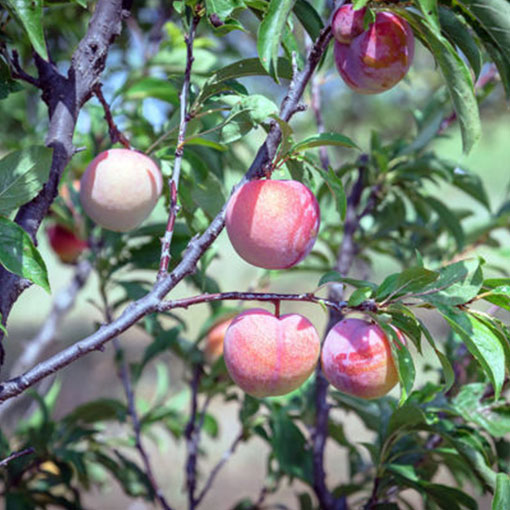
This tree produces a large, 2 - 2 1/2" smooth, fuzzless, deep yellow skinned fruit with an orange red blush. It has firm, deep orange flesh. Freestone.
A large yellow variety that bears from July to late August. Juicy, sweet tasting fruit which are good fresh, or for canning and drying. This landscape tree has attractive showy whitish-pink blossom and is a self-polinating tree but planting two varieties is recommended for a better crop. (Zones 4-8)
| Spring Shipping | Fall Shipping | ||||
|---|---|---|---|---|---|
| Color | Zone |
Approximate Ship Dates |
Order Deadline |
Approximate Ship Dates |
Order Deadline |
| 2 | 04/15–05/30 | 05/14 | 11/01–11/26 | 11/12 | |
| 3 | 04/15–05/30 | 05/14 | 11/01–11/26 | 11/12 | |
| 4 | 04/15–05/30 | 05/14 | 11/01–11/26 | 11/12 | |
| 5 | 04/15–05/30 | 05/14 | 11/01–11/26 | 11/12 | |
| 6 | 03/19–05/12 | 05/07 | 11/01–12/03 | 11/19 | |
| 7 | 03/11–05/07 | 04/30 | 11/05–12/10 | 11/26 | |
| 8 | 02/26–04/30 | 04/23 | 11/05–12/10 | 11/26 | |
| 9 | 02/26–04/30 | 04/23 | 11/05–12/10 | 11/26 | |
| 10 | 02/26–04/30 | 04/23 | 11/05–12/10 | 11/26 | |
When you order trees from The Arbor Day Foundation, your order is guaranteed to arrive in a good, healthy condition or we'll replace them at no charge. Your trees will be shipped at a suitable time for planting.
Each tree is guaranteed to grow, or we'll replace it at one half the original price, plus shipping and handling.
The benefits of bare-root trees
Our trees are delivered with natural bare roots which have been dipped in hydrating gel prior to shipment to keep the roots moist and healthy. As their abundant, fibrous roots aren't confined by a container, bare-root trees get off to a more vigorous start compared to containerized roots which typically need more time to adjust to transplanting. Bare-root trees typically surpass the size of larger containerized trees in only a few years.


Natural root (also called bare root) trees are shipped without soil around their roots. They are shipped when dormant in the spring and fall seasons. We dip the roots in a hydrating gel to keep them moist during shipping.
Potted (also called containerized) trees come in 4" containers.