Shop
September Everbearing Raspberry—Rubus idaeus 'September'

September Everbearing Raspberry

Rubus idaeus 'September'

  • One of the Most Popular Red Raspberry Cultivars
  • Two Harvest Seasons: Summer and Fall
  • Produces Fruit in First Season
  • Medium-Size, Juicy, Tart Berries
  • Self Pollinating
  • Zones 3-7
  • Can't Ship: AK, AZ, HI
  • SPRING SHIPPING ONLY
Guaranteed Healthy Delivery
Item # 6765 | Shipping Height: 1/2' - 1'
*Mem. Price:$9.98
Reg. Price:$15.00
Quantity:

Note: This tree only ships during the Spring Shipping season.

* Not a member? Join during checkout and get member pricing immediately.

Click icons for more information Show All Hide All

Zones 3 - 7
Zones 3 - 7

Hardiness Zones: Zones 3 - 7
The September Everbearing Raspberry can be expected to grow in the zones shown in color in the arborday.org zone map.VIEW MAP

fruit tree
fruit tree

Type of tree:
The September Everbearing Raspberry falls into the following type(s): Fruit Trees, Shrubs

3' - 4' High
3' - 4' High

Mature Height:
The September Everbearing Raspberry grows to be 3' - 4' feet in height.

2' - 4' Spread
2' - 4' Spread

Mature Spread:
The September Everbearing Raspberry has a spread of about 2' - 4' at full maturity.

Medium to Fast Growth

Growth Rate:
This tree grows at a medium to fast growth rate. [More about this.]

Full Sun
Full Sun

Sun:
This raspberry does well in full sun.

Various Soils
Various Soils

Soil:
The September Everbearing Raspberry grows in acidic, loamy, moist, rich, sandy, silty loam, well drained, wide range, clay soils.

Rounded Shape
Rounded Shape

Shape:
This raspberry has rounded shape.

More Info
More Info

Bloom Time:
April-May.

Fruit Description:
Medium to large-size, juicy, tart, rose-red raspberries with small seeds.

September Everbearing Raspberry is one of the most popular home and commercial cultivars. It produces crops in two seasons, with a light crop in June followed by a heavy crop in September. Medium-size, tart, juicy, rose-red raspberries with small seeds. Excellent fresh, frozen, and in preserves and pies. Good for cold climates with cool summers. Self pollinating, acidic to slightly basic soil and adapts to a wide range of soil types. 2' tall 2' wide. Shipped as 1-year-old, #1 bareroot canes 6- 12 inches tall (zones 3 – 7).

Planting instructions: These raspberries prefer a deep, well-drained, fertile soil and typically bear fruit producing on first-year wood. Space 30 inches in a row with 8'-10' between rows. Create a simple T trellis at about knee height with a top 1 1/2 feet wide to support the canes. This can be made using rebar or wood with twine or wire strung down each side of the row They thrive in most soil types. Your plants require 1 inch of water per week during the growing season and regular, shallow cultivation.

Learn more about planting and caring for your raspberries

Watch a video and learn about growing raspberries

Learn how to prune raspberries

Arborday.org Hardiness Zone Map
Spring Shipping Fall Shipping
Color Zone Approximate
Ship Dates
Order
Deadline
Approximate
Ship Dates
Order
Deadline
  2 04/15–05/30 05/14 11/01–11/26 11/12
  3 04/15–05/30 05/14 11/01–11/26 11/12
  4 04/15–05/30 05/14 11/01–11/26 11/12
  5 04/15–05/30 05/14 11/01–11/26 11/12
  6 03/19–05/12 05/07 11/01–12/03 11/19
  7 03/11–05/07 04/30 11/05–12/10 11/26
  8 02/26–04/30 04/23 11/05–12/10 11/26
  9 02/26–04/30 04/23 11/05–12/10 11/26
  10 02/26–04/30 04/23 11/05–12/10 11/26
We're sorry, but this tree can't be shipped to AK, AZ, HI , territories, or countries outside the U.S. This is due to the agricultural laws within these locations.

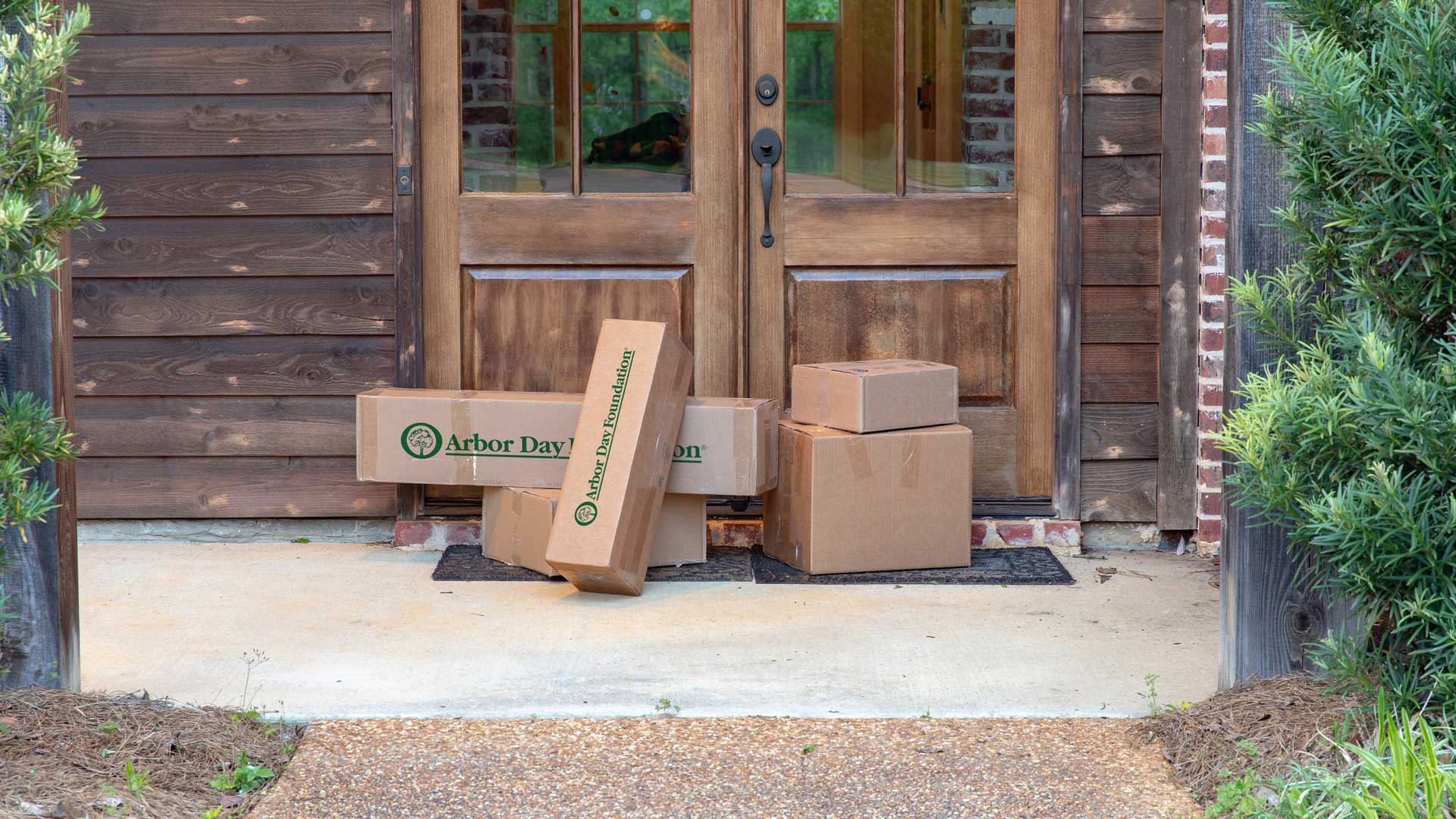
When you order trees from The Arbor Day Foundation, your order is guaranteed to arrive in a good, healthy condition or we'll replace them at no charge. Your trees will be shipped at a suitable time for planting.

Each tree is guaranteed to grow, or we'll replace it at one half the original price, plus shipping and handling.

The benefits of bare-root trees

Our trees are delivered with natural bare roots which have been dipped in hydrating gel prior to shipment to keep the roots moist and healthy. As their abundant, fibrous roots aren't confined by a container, bare-root trees get off to a more vigorous start compared to containerized roots which typically need more time to adjust to transplanting. Bare-root trees typically surpass the size of larger containerized trees in only a few years.

  Standard Dwarf
  Mature
Height
Space
Needed
Mature
Height
Space
Needed
Apple 20' - 25' 35' x 35'

10' **

10' x 10' ++
Peach 20' 20' x 20' 8' - 10' 10' x 10'
Sweet Cherry 30' 20' x 25' 12' - 15' 10' x 10'
Sour Cherry 20' 20' x 20' 8' 10' x 10'
Pear 20' 20' x 20' 12' - 15' 12' x 12'
Apricot 20' 20' x 20'    
Plum 20' 20' x 20' 8' - 10' 10' x 10'
      ** semi-dwarf 12' - 15'
++ semi-dwarf 12' x 12'

Natural Root and Containerized Trees

Natural root (also called bare root) trees are shipped without soil around their roots. They are shipped when dormant in the spring and fall seasons. We dip the roots in a hydrating gel to keep them moist during shipping.

There are a number of advantages to natural root trees:

  • They are very affordable.
  • Their roots re-establish themselves well once they are planted in their permanent location.
  • They are easy to plant at the correct depth.

The Urban Horticulture Institute at Cornell University has an interesting article about the benefits of planting natural root trees. Look for the PDF entitled Creating the Urban Forest: The Bare Root Method

Potted (also called containerized) trees come in 4" containers.


If you have questions, please call (888) 448-7337 or E-mail Member Services.