Shop
Atlas Cedar—Cedrus atlantica

Atlas Cedar

Cedrus atlantica

  • Silvery Bluish-Green Needles
  • Long Living Evergreen
  • Distinctive Purple Female Cones
  • Grows 40' to 60' high with 30' to 40' spread
  • Zones 6 to 9
Guaranteed Healthy Delivery
Item # 3779 | Shipping Height: 9" - 12"
*Mem. Price:$6.98
Reg. Price:$10.50
Quantity:

* Not a member? Join during checkout and get member pricing immediately.

Click icons for more information Show All Hide All

Zones 6 - 9
Zones 6 - 9

Hardiness Zones: Zones 6 - 9
The Atlas Cedar can be expected to grow in the zones shown in color in the arborday.org zone map.VIEW MAP

evergreen
evergreen

Type of tree:
The Atlas Cedar falls into the following type(s): Evergreens

40' - 60' High
40' - 60' High

Mature Height:
The Atlas Cedar grows to be 40' - 60' feet in height.

30' - 40' Spread
30' - 40' Spread

Mature Spread:
The Atlas Cedar has a spread of about 30' - 40' at full maturity.

Slow Growth
Slow Growth

Growth Rate:
This tree grows at a slow growth rate. [More about this.]

Multiple Exposures
Multiple Exposures

Sun:
This cedar does well in full sun, partial shade.

Various Soils
Various Soils

Soil:
The Atlas Cedar grows in acidic, alkaline, drought tolerant, loamy, moist, rich, sandy, silty loam, well drained soils.

Pyramidal Shape
Pyramidal Shape

Shape:
This cedar has pyramidal shape.

More Info
More Info

Attributes:
The wood of the Atlas is oily, scented and durable. This wood is widely used for construction, furniture (especially cedar chests) and railroad ties. The oil in the wood wards off attacks from insects.

Wildlife Value:
The Middle Atlas Cedar forest of Morocco is the last suitable habitat for the Barbary macaque. Unfortunately, however, the forest suffered due to a dramatic increase in the macaque's stripping the bark off the trees, possibly due to the increase in the macaque population. It has been theorized that the macaques' are stripping the bark in an effort to get water, as the behavior is seen primarily where there wasn't a ready supply of water. The trunk attracts sapsuckers but the small holes they drill do little lasting harm. Rather than try and move the population of macaques and risk the extinction of the species, the University of Padova in Italy suggests that the Moroccan government increase the supply of water.

History/Lore/Use:
The Atlas Cedar was introduced into this country in 1845 and is a prized specimen tree, however it has not been very successful as a forestry product. This tree, along with the Deodar Cedar and Cedar of Lebanon are true cedars. Trees such as the Redcedar, which is really a member of the Juniper family, and the Western Redcedar, which is really an Arborvitae, are commonly thought of as Cedars because of their appearance and aromatic wood.

Moisture:
The Atlas Cedar prefers moist soil and can also tolerate moderate drought.

Leaves:
The needles are blue-green and measure 3/4 to 1-1/2" in length.

Flower Color:
The blooms of the Atlas Cedar are indistinguishable.

Bloom Time:
The Atlas Cedar blooms in the spring..

Fruit Description:
The Atlas Cedar produces 2 1/4"-4" long cones that turn brown at maturity.

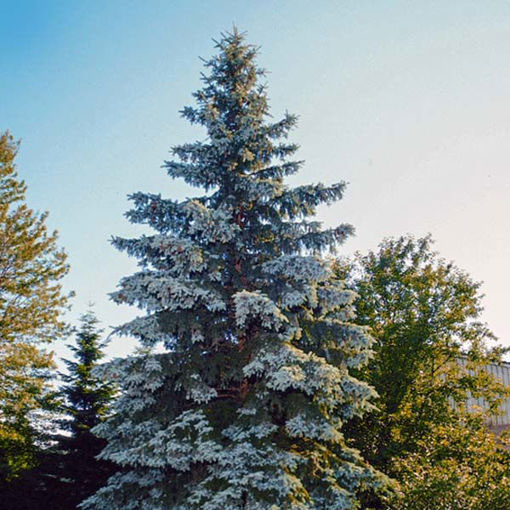
A distinctive evergreen with silvery blue to bluish-green needles. Pyramidal in its youth, it becomes massive with horizontal, spreading branches and is quite a sight. The Atlas Cedar lives long and requires a lot of space to develop freely. 2"-3' male cones form on lower part of tree, with larger purple female cones developing on top branches. Tolerates many soil conditions, but prefers moist and well-drained soils. Grows 40'-60' high with a 30'-40' spread.

Arborday.org Hardiness Zone Map
Spring Shipping Fall Shipping
Color Zone Approximate
Ship Dates
Order
Deadline
Approximate
Ship Dates
Order
Deadline
  2 04/15–05/30 05/14 11/01–11/26 11/12
  3 04/15–05/30 05/14 11/01–11/26 11/12
  4 04/15–05/30 05/14 11/01–11/26 11/12
  5 04/15–05/30 05/14 11/01–11/26 11/12
  6 03/19–05/12 05/07 11/01–12/03 11/19
  7 03/11–05/07 04/30 11/05–12/10 11/26
  8 02/26–04/30 04/23 11/05–12/10 11/26
  9 02/26–04/30 04/23 11/05–12/10 11/26
  10 02/26–04/30 04/23 11/05–12/10 11/26
We're sorry, but this tree can't be shipped to AK, AZ, HI , territories, or countries outside the U.S. This is due to the agricultural laws within these locations.

When you order trees from The Arbor Day Foundation, your order is guaranteed to arrive in a good, healthy condition or we'll replace them at no charge. Your trees will be shipped at a suitable time for planting.

Each tree is guaranteed to grow, or we'll replace it at one half the original price, plus shipping and handling.

The benefits of bare-root trees

Our trees are delivered with natural bare roots which have been dipped in hydrating gel prior to shipment to keep the roots moist and healthy. As their abundant, fibrous roots aren't confined by a container, bare-root trees get off to a more vigorous start compared to containerized roots which typically need more time to adjust to transplanting. Bare-root trees typically surpass the size of larger containerized trees in only a few years.

  Standard Dwarf
  Mature
Height
Space
Needed
Mature
Height
Space
Needed
Apple 20' - 25' 35' x 35'

10' **

10' x 10' ++
Peach 20' 20' x 20' 8' - 10' 10' x 10'
Sweet Cherry 30' 20' x 25' 12' - 15' 10' x 10'
Sour Cherry 20' 20' x 20' 8' 10' x 10'
Pear 20' 20' x 20' 12' - 15' 12' x 12'
Apricot 20' 20' x 20'    
Plum 20' 20' x 20' 8' - 10' 10' x 10'
      ** semi-dwarf 12' - 15'
++ semi-dwarf 12' x 12'

Natural Root and Containerized Trees

Natural root (also called bare root) trees are shipped without soil around their roots. They are shipped when dormant in the spring and fall seasons. We dip the roots in a hydrating gel to keep them moist during shipping.

There are a number of advantages to natural root trees:

  • They are very affordable.
  • Their roots re-establish themselves well once they are planted in their permanent location.
  • They are easy to plant at the correct depth.

The Urban Horticulture Institute at Cornell University has an interesting article about the benefits of planting natural root trees. Look for the PDF entitled Creating the Urban Forest: The Bare Root Method

Potted (also called containerized) trees come in 4" containers.


If you have questions, please call (888) 448-7337 or E-mail Member Services.