Burbank Plum
Prunus salicina
- Most popular commercial variety
- Produces purplish-red plum
- Grows to 10' to 35' with 10' to 20' spread
- Zones 5 to 9
- Can't Ship To: AK, AL, AR, AZ, CA, HI, ID, LA, OR, SC, WA, CO
* Not a member? Join during checkout and get member pricing immediately.

Zones 5 - 9
The Burbank Plum can be expected to grow in the zones shown in color in the arborday.org zone map.VIEW MAP

fruit tree
The Burbank Plum falls into the following type(s): Fruit Trees

10' - 35' High
The Burbank Plum grows to be 10' - 35' feet in height.

10' - 20' Spread
The Burbank Plum has a spread of about 10' - 20' at full maturity.

Medium Growth
This tree grows at a medium growth rate. [More about this.]

Full Sun
This plum does well in full sun.

Various Soils
This tree grows in a wide variety of soil types and has some tolerance for heavy and waterlogged soils. It prefers a well drained, loamy, mildly acidic to mildly alkaline soil.

Irregular Shape
This plum has irregular shape.

More Info
Attributes:
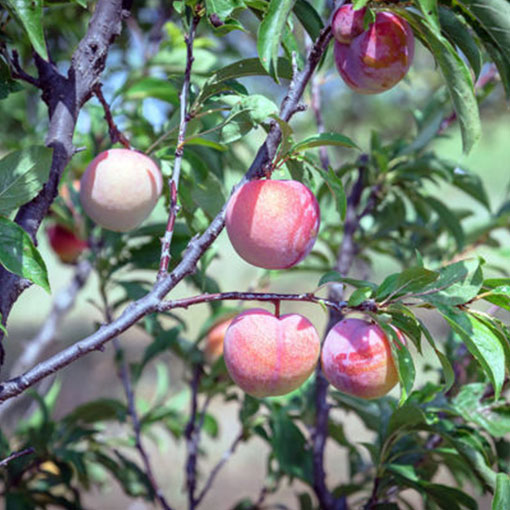
A hardy plum tree that bears early and sets heavy crops for the home orchard or commercial production. It adapts to a wide variety of growing conditions. Profuse delicate white flowers bloom early in the spring. The large bright reddish purple fruit has sweet, juicy, amber colored flesh with an excellent flavor. The Burbank plum is particularly good for eating fresh, canning, or making into jam and jelly.
Wildlife Value:
Plum trees provide food and cover for butterfly larva, birds, and mammals
History/Lore/Use:
Burbank plum was developed from a seed sent to the legendary plant breeder, Luther Burbank, in 1883. Its parentage can be traced to China, but for the past 400 years or more the tree has been cultivated by the Japanese giving the genus its common name, Japanese plums. There are over 200 varieties of plums grown commercially, but nearly all of California's have been derived form the Japanese plum and Burbank's experiment with cross breeding.
Height Variations:
The standard grows to 35', and dwarf grows to 8' - 10' in height.
Spread Variations:
Standard to 20' dwarf to 10'
Moisture:
This tree requires moisture, but does well where rainfall and low humidity are minimal during the growing season.
Leaves:
Simple, alternate,ovate or elliptic with acute or obtuse tips, finely toothed at the margins, often folded upward along the midrib. Bright green on top, light colored beneath and sometimes with fine hairs.
Flower Color:
White
Bloom Time:
Early.
Fruit Description:
Red and golden yellow skin. Firm, sweet, aromatic, juicy and uniquely flavored.
Purplish-red plum. Most popular commercial variety. (Pollinate with a different Japanese plum variety). (zones 5–9)
| Spring Shipping | Fall Shipping | ||||
|---|---|---|---|---|---|
| Color | Zone |
Approximate Ship Dates |
Order Deadline |
Approximate Ship Dates |
Order Deadline |
| 2 | 04/15–05/30 | 05/14 | 11/01–11/26 | 11/12 | |
| 3 | 04/15–05/30 | 05/14 | 11/01–11/26 | 11/12 | |
| 4 | 04/15–05/30 | 05/14 | 11/01–11/26 | 11/12 | |
| 5 | 04/15–05/30 | 05/14 | 11/01–11/26 | 11/12 | |
| 6 | 03/19–05/12 | 05/07 | 11/01–12/03 | 11/19 | |
| 7 | 03/11–05/07 | 04/30 | 11/05–12/10 | 11/26 | |
| 8 | 02/26–04/30 | 04/23 | 11/05–12/10 | 11/26 | |
| 9 | 02/26–04/30 | 04/23 | 11/05–12/10 | 11/26 | |
| 10 | 02/26–04/30 | 04/23 | 11/05–12/10 | 11/26 | |
When you order trees from The Arbor Day Foundation, your order is guaranteed to arrive in a good, healthy condition or we'll replace them at no charge. Your trees will be shipped at a suitable time for planting.
Each tree is guaranteed to grow, or we'll replace it at one half the original price, plus shipping and handling.
The benefits of bare-root trees
Our trees are delivered with natural bare roots which have been dipped in hydrating gel prior to shipment to keep the roots moist and healthy. As their abundant, fibrous roots aren't confined by a container, bare-root trees get off to a more vigorous start compared to containerized roots which typically need more time to adjust to transplanting. Bare-root trees typically surpass the size of larger containerized trees in only a few years.


Natural root (also called bare root) trees are shipped without soil around their roots. They are shipped when dormant in the spring and fall seasons. We dip the roots in a hydrating gel to keep them moist during shipping.
Potted (also called containerized) trees come in 4" containers.