Shop

Baldcypress

Taxodium distichum

  • Majestic Orange-Red Fall Color
  • Great Urban Tree
  • Pale Green, Semi-Evergreen Leaves
  • Zones 4 to 10
  • 50' to 70' High by 25' Wide
  • Can't Ship To: AK, AZ, HI
Guaranteed Healthy Delivery
Item # 1199 | Shipping Height: 2' - 3'
*Mem. Price:$5.49
Reg. Price:$8.50
Quantity:

* Not a member? Join during checkout and get member pricing immediately.

Click icons for more information Show All Hide All

Zones 4 - 10
Zones 4 - 10

Hardiness Zones: Zones 4 - 10
The Baldcypress can be expected to grow in the zones shown in color in the arborday.org zone map.VIEW MAP

shade tree
shade tree

Type of tree:
The Baldcypress falls into the following type(s): Shade Trees

50' - 70' High
50' - 70' High

Mature Height:
The Baldcypress grows to be 50' - 70' feet in height.

25' Spread
25' Spread

Mature Spread:
The Baldcypress has a spread of about 25' at full maturity.

Medium Growth
Medium Growth

Growth Rate:
This tree grows at a medium growth rate. [More about this.]

Full Sun
Full Sun

Sun:
This Baldcypress does well in full sun.

Various Soils
Various Soils

Soil:
The Baldcypress grows in acidic, drought tolerant, loamy, moist, sandy, silty loam, well drained, wet, clay soils.

Pyramidal Shape
Pyramidal Shape

Shape:
This Baldcypress has pyramidal, upright or erect shape.

More Info
More Info

Attributes:
The Baldcypress tree is the classic tree of southern swamps. There, in its native habitat, it displays a peculiar habit of raising conical "knees" from its roots. The function of these growths is something of a mystery, although some believe it is a way to help the roots get oxygen. This tree dwells in swamps because it out-competes most other trees on such sites. To the surprise of some people, when the Baldcypress is planted on the right soil in yards or along streets, it does quite well and is a beautiful specimen tree. It has been grown successfully in cities as far north as Milwaukee and on dry Texas hills.

Wildlife Value:
Baldcypress form characteristic groves in swampy areas that support complex and variable ecosystems, and are used by many wildlife species.

History/Lore/Use:
Baldcypress trees are native from Maryland along the eastern coast to Texas and as far west as the Mississippi valley. The first scientific reference to the species was made in 1640. This tree has inspired much poetry and prose over the centuries due to its melancholy and mysterious appearance. Longfellow refers to its "towering and tenebrous boughs" that " Waved like banners that hang on the walls of ancient cathedrals" in his 1847 poem, "Evangeline." Naturalist John Muir in his book "Thousand-Mile Walk" refers to "the dark, mysterious cypress woods which cover everything" and states that "Night is coming on and I am filled with indescribable loneliness."

Moisture:
It is adaptable to wet or dry conditions, and can withstand flooding.

Leaves:
This tree's leaves alternate and are two-ranked, simple, semi-evergreen, and pale green color.

Flower Color:
Brown, faded flower color. Not noteworthy.

Bloom Time:
April-May.

Fruit Description:
The fruit is oval, 1 inch long, attractive to wildlife.

A stately deciduous conifer adaptable to wet or dry conditions. Best known in wet areas, does well in city conditions. The pale green leaves turn majestic orange-red in the fall, giving it one of the most unique fall colored trees. The Baldcypress was made famous for its "Cypress knees" in southern swamps, the knees occur only near water. Prefers acid soils. Grows to 50' - 70', 25'or more spread. (zones 4-10)

Arborday.org Hardiness Zone Map
Spring Shipping Fall Shipping
Color Zone Approximate
Ship Dates
Order
Deadline
Approximate
Ship Dates
Order
Deadline
  2 04/15–05/30 05/14 11/01–11/26 11/12
  3 04/15–05/30 05/14 11/01–11/26 11/12
  4 04/15–05/30 05/14 11/01–11/26 11/12
  5 04/15–05/30 05/14 11/01–11/26 11/12
  6 03/19–05/12 05/07 11/01–12/03 11/19
  7 03/11–05/07 04/30 11/05–12/10 11/26
  8 02/26–04/30 04/23 11/05–12/10 11/26
  9 02/26–04/30 04/23 11/05–12/10 11/26
  10 02/26–04/30 04/23 11/05–12/10 11/26
We're sorry, but this tree can't be shipped to AK, AZ, HI , territories, or countries outside the U.S. This is due to the agricultural laws within these locations.

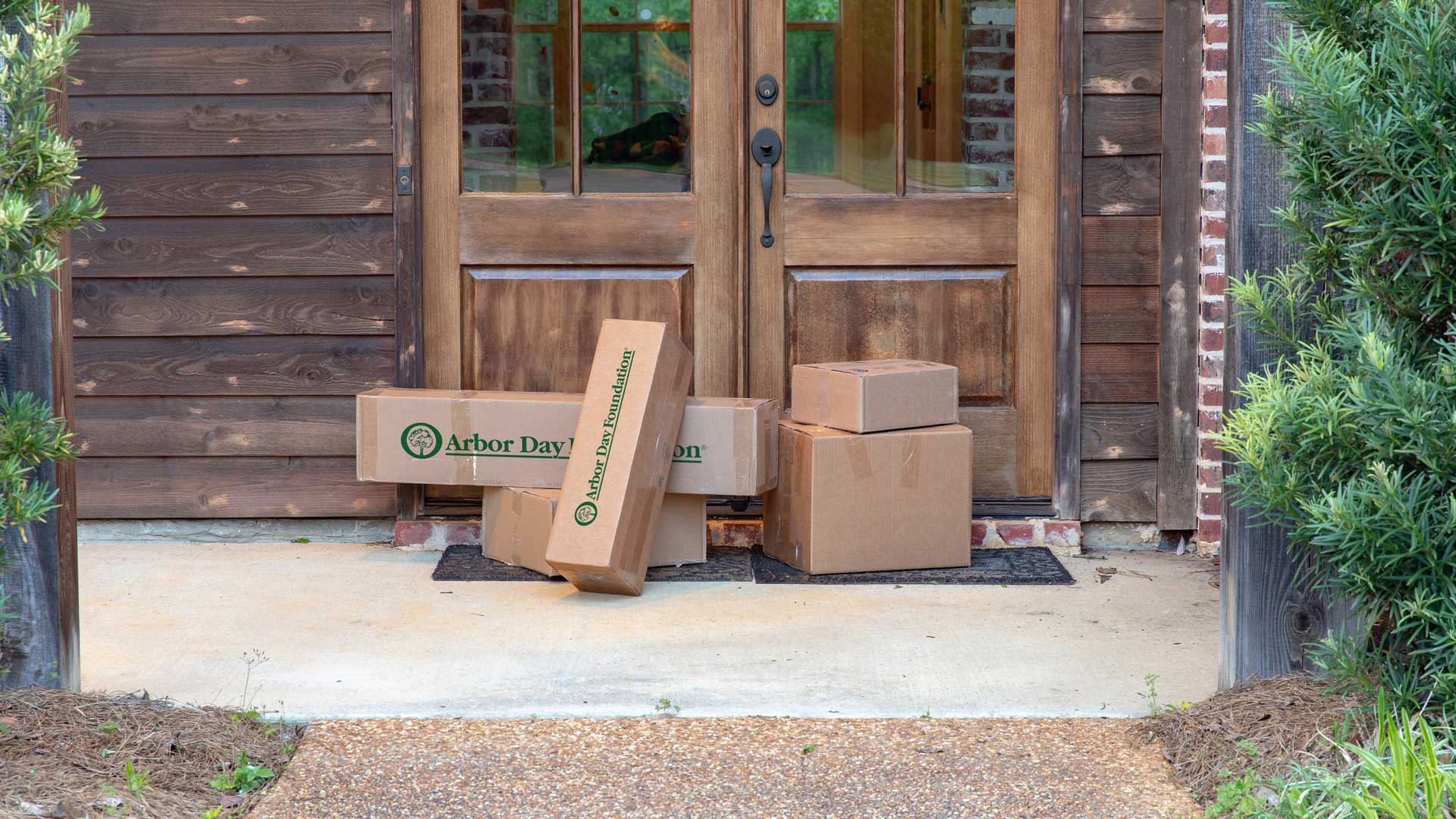
When you order trees from The Arbor Day Foundation, your order is guaranteed to arrive in a good, healthy condition or we'll replace them at no charge. Your trees will be shipped at a suitable time for planting.

Each tree is guaranteed to grow, or we'll replace it at one half the original price, plus shipping and handling.

The benefits of bare-root trees

Our trees are delivered with natural bare roots which have been dipped in hydrating gel prior to shipment to keep the roots moist and healthy. As their abundant, fibrous roots aren't confined by a container, bare-root trees get off to a more vigorous start compared to containerized roots which typically need more time to adjust to transplanting. Bare-root trees typically surpass the size of larger containerized trees in only a few years.

  Standard Dwarf
  Mature
Height
Space
Needed
Mature
Height
Space
Needed
Apple 20' - 25' 35' x 35'

10' **

10' x 10' ++
Peach 20' 20' x 20' 8' - 10' 10' x 10'
Sweet Cherry 30' 20' x 25' 12' - 15' 10' x 10'
Sour Cherry 20' 20' x 20' 8' 10' x 10'
Pear 20' 20' x 20' 12' - 15' 12' x 12'
Apricot 20' 20' x 20'    
Plum 20' 20' x 20' 8' - 10' 10' x 10'
      ** semi-dwarf 12' - 15'
++ semi-dwarf 12' x 12'

Natural Root and Containerized Trees

Natural root (also called bare root) trees are shipped without soil around their roots. They are shipped when dormant in the spring and fall seasons. We dip the roots in a hydrating gel to keep them moist during shipping.

There are a number of advantages to natural root trees:

  • They are very affordable.
  • Their roots re-establish themselves well once they are planted in their permanent location.
  • They are easy to plant at the correct depth.

The Urban Horticulture Institute at Cornell University has an interesting article about the benefits of planting natural root trees. Look for the PDF entitled Creating the Urban Forest: The Bare Root Method

Potted (also called containerized) trees come in 4" containers.


If you have questions, please call (888) 448-7337 or E-mail Member Services.