White Pine
Pinus strobus
- Hardy Tree
- Ideal for screens or windbreaks
- Fast Growing Pine Tree
- Grows to 50' to 80' with 20' to 40' spread
- Zones 3 to 8
- Can't Ship To: AK, AZ, CA, HI, ID, MT, OR, UT
* Not a member? Join during checkout and get member pricing immediately.

Zones 3 - 8
The White Pine can be expected to grow in the zones shown in color in the arborday.org zone map.VIEW MAP

evergreen
The White Pine falls into the following type(s): Evergreens

50' - 80' High
The White Pine grows to be 50' - 80' feet in height.

20' - 40' Spread
The White Pine has a spread of about 20' - 40' at full maturity.

Fast Growth
This tree grows at a fast growth rate. [More about this.]

Multiple Exposures
This pine does well in full sun, partial shade.

Various Soils
Well-drained, moist, acidic, dry, wet soils

Oval Shape
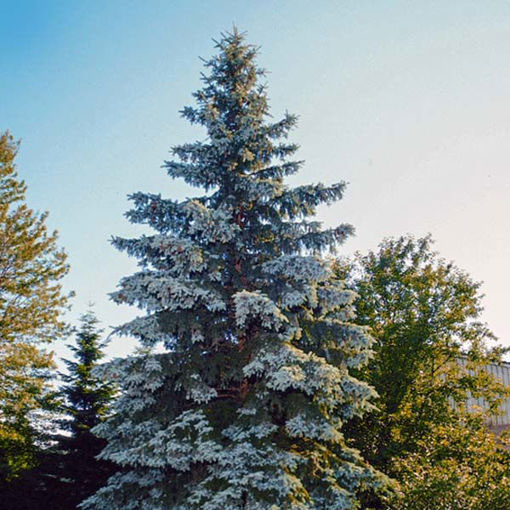
This pine has oval, pyramidal shape.

More Info
Attributes:
The ease of transplanting and rapid growth of the White Pine tree make it an ideal candidate for landscape and windscreen applications. Wildlife that eat the seeds range form chickadees and game birds to rabbits and black bears. White Pines are widely used as Christmas trees and are still very important as a lumber source.
Wildlife Value:
White pine seeds are favored by black bears, rabbits, red squirrels, and many birds, especially red crossbills. While potentially damaging to the trees, the bark is eaten by mammals such as beavers, snowshoe hares, porcupines, rabbits and mice. White pines provide nesting sites as well for many birds, including woodpeckers, common grackles, mourning doves, chickadees and nuthatches.
History/Lore/Use:
The Eastern White Pine tree has been referred to as "the monarch of the forest." Some that greeted the first settlers reached a height of 250 feet with diameters of 6 feet. They were a bonanza for England in colonial times, as they met a vital military and commercial need for sailing ship masts.
Since the colonists were rapidly using up the existing supply of trees close to the ocean that were large enough for masts, the Royal Navy appealed to Parliament. As a result, in 1691 Great Britain imposed the first of the so-called "broad arrow" acts, so named because of the axe mark placed on the reserved trees by the king's men, that reserved these trees for the English government. Growing resentment to the crown's appropriation of the choicest White Pines helped precipitate the Revolutionary War, and the first flag of the revolutionary forces even had a White Pine as its emblem.
Moisture:
Does best in moist soil conditions, but can tolerate dry, rocky ridges to bogs.
Leaves:
The leaves are spiral shaped, flexible, five needles, 2 to 5 inches long.
Flower Color:
Pink; yellow; nondescript.
Bloom Time:
April-May.
Fruit Description:
The fruit is an elongated cone, 6 to 8 inches long, dry, brown.
A hardy, valuable tree. Clustered soft blue-green needles. Ideal screen or windbreak. Likes moist, well-drained soils. Grows 50'- 80' with a 20-40' spread in the landscape, up to 150' or more in the wild. (zones 3-8)
| Spring Shipping | Fall Shipping | ||||
|---|---|---|---|---|---|
| Color | Zone |
Approximate Ship Dates |
Order Deadline |
Approximate Ship Dates |
Order Deadline |
| 2 | 04/15–05/30 | 05/14 | 11/01–11/26 | 11/12 | |
| 3 | 04/15–05/30 | 05/14 | 11/01–11/26 | 11/12 | |
| 4 | 04/15–05/30 | 05/14 | 11/01–11/26 | 11/12 | |
| 5 | 04/15–05/30 | 05/14 | 11/01–11/26 | 11/12 | |
| 6 | 03/19–05/12 | 05/07 | 11/01–12/03 | 11/19 | |
| 7 | 03/11–05/07 | 04/30 | 11/05–12/10 | 11/26 | |
| 8 | 02/26–04/30 | 04/23 | 11/05–12/10 | 11/26 | |
| 9 | 02/26–04/30 | 04/23 | 11/05–12/10 | 11/26 | |
| 10 | 02/26–04/30 | 04/23 | 11/05–12/10 | 11/26 | |
When you order trees from The Arbor Day Foundation, your order is guaranteed to arrive in a good, healthy condition or we'll replace them at no charge. Your trees will be shipped at a suitable time for planting.
Each tree is guaranteed to grow, or we'll replace it at one half the original price, plus shipping and handling.
The benefits of bare-root trees
Our trees are delivered with natural bare roots which have been dipped in hydrating gel prior to shipment to keep the roots moist and healthy. As their abundant, fibrous roots aren't confined by a container, bare-root trees get off to a more vigorous start compared to containerized roots which typically need more time to adjust to transplanting. Bare-root trees typically surpass the size of larger containerized trees in only a few years.


Natural root (also called bare root) trees are shipped without soil around their roots. They are shipped when dormant in the spring and fall seasons. We dip the roots in a hydrating gel to keep them moist during shipping.
Potted (also called containerized) trees come in 4" containers.